Gulf producers accelerate plans to route oil away from Hormuz
Trump’s proposed 20% Hormuz cargo fee and U.S.-Iran tensions are increasing pressure on Gulf exporters to expand routes outside the key strait.
By Amanda Ross · Deals Correspondent
· 3 min read
President Donald Trump’s threat to levy a 20% charge on cargo moving through the Strait of Hormuz, together with renewed U.S.-Iran tensions, has intensified Gulf efforts to keep oil exports flowing through routes outside the waterway. Saudi Arabia is moving roughly 4 million barrels a day through its East-West pipeline, while the International Energy Agency says only Saudi Arabia and the United Arab Emirates have operating crude pipelines that can bypass Hormuz.
The push reflects a practical constraint for energy markets: alternative routes can reduce exposure to the strait, but they cannot yet replace it for the wider Gulf. The IEA estimates Saudi Arabia and the UAE have 3.5 million to 5.5 million barrels a day of available bypass capacity, while Iraq, Kuwait, Qatar, Bahrain and Iran still depend on Hormuz for most oil shipments.
UAE looks east for capacity
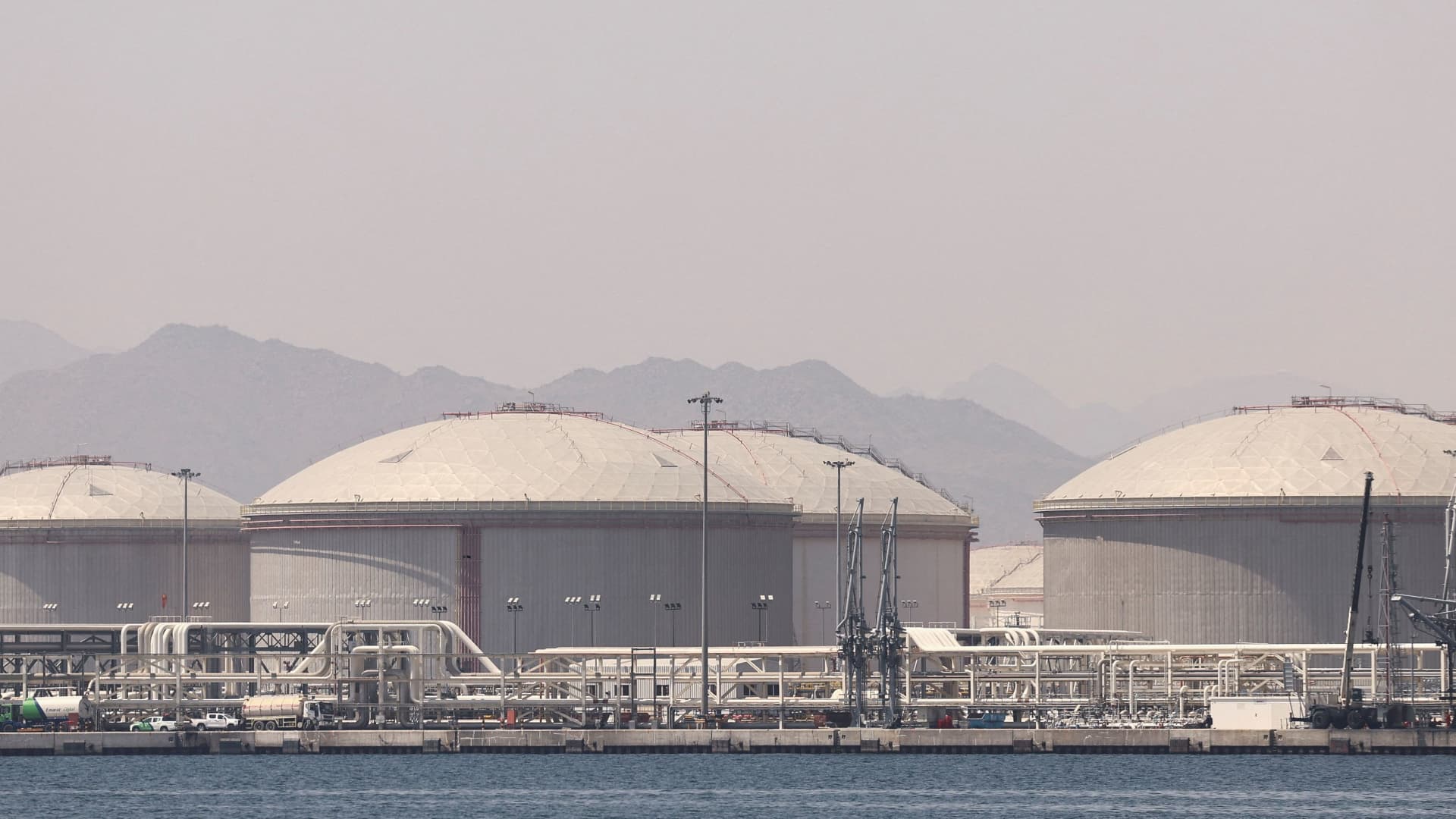
The UAE is seeking to expand export infrastructure on its east coast, outside the Strait of Hormuz, according to reporting by the Financial Times. The newspaper said DP World, the Dubai-based ports group, has held talks on developing a new port in Fujairah and adding a terminal at the emirate’s existing harbor, citing people familiar with the matter.
DP World declined to comment to CNBC. The project would add to Fujairah’s role as a logistics and energy hub on the Gulf of Oman, reducing reliance on Dubai’s Jebel Ali port for some cargo flows that would otherwise be tied more closely to access through Hormuz.
Ahmed bin Sulayem, chief executive of the Dubai Multi Commodities Centre, told CNBC that reported UAE plans for port and terminal capacity outside the strait amount to both a near-term response and a longer-term strategy. He said shipping lines were unlikely to focus heavily on Hormuz until conditions there became safer.
Saudi pipeline carries more crude west
Saudi Arabia’s main bypass route is the East-West pipeline, also known as Petroline. The system runs about 750 miles from Abqaiq in the kingdom’s eastern oil region to Yanbu on the Red Sea, allowing crude to move across Saudi territory before being loaded onto tankers away from the Gulf.
Andy Lipow, president of Lipow Oil Associates, said Saudi Arabia has been routing about 4 million barrels a day through the line to Yanbu. The network’s design capacity is estimated at 7 million barrels a day following recent expansions.
Bob McNally, president of Rapidan Energy Group, told CNBC that Saudi Arabia’s ability to move additional barrels through Yanbu had been a notable operational success. He also said the UAE, with U.S. military assistance, appeared to be returning toward pre-war export levels.
The UAE has also chartered tankers to move crude from inside Hormuz to waters beyond the strait, where cargo can be transferred to larger vessels bound for Asia, according to Lipow. That process, known as lightering, uses smaller or more flexible ships to reposition cargo before loading it onto long-haul tankers.
Risk shifts to other corridors
Bypassing Hormuz reduces one exposure while creating others. Tankers leaving Yanbu enter the Red Sea and must pass near the Bab el-Mandeb Strait, where Houthi attacks have threatened shipping. Lipow said interference with those vessels could remove several million barrels a day from the market.
Carole Nakhle, chief executive of Crystol Energy, told CNBC the UAE has moved faster than many regional peers to present alternatives to Hormuz. She said lower exposure to the strait could also give Abu Dhabi more leverage in any future dealings with Iran.
Large gaps remain. Lipow said Saudi Arabia, Kuwait and Iraq could face pressure to reverse recent production increases if storage fills and tankers cannot reach export terminals. Adam Posen, president of the Peterson Institute for International Economics, told CNBC that building enough pipelines, shipping options and other workarounds to lower reliance on Hormuz could take 18 to 24 months.
This story draws on original reporting from CNBC.


