US productivity gains predate broad generative AI adoption
Labor output per hour has accelerated for years, with tight labor markets, digitisation and remote work cited as key drivers.
By Amanda Ross · Deals Correspondent
· 3 min read
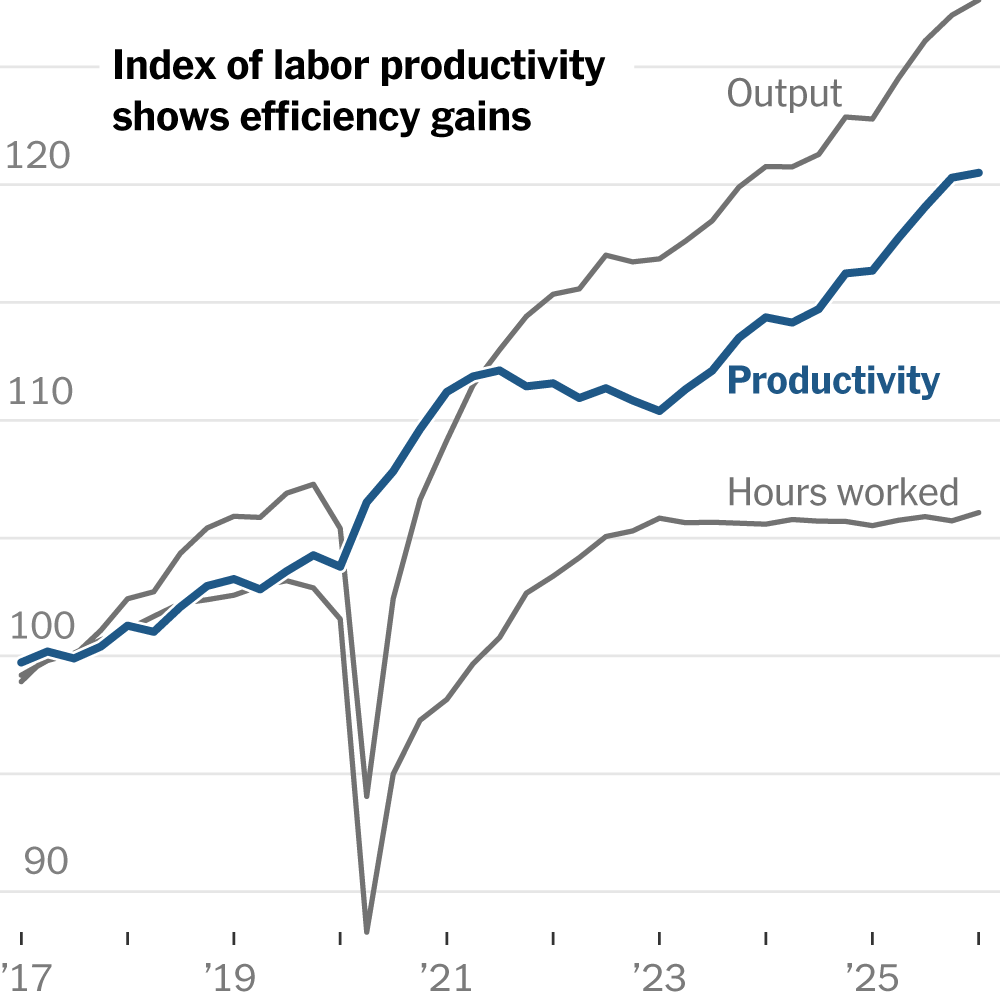
US labour productivity has been rising for several years at its strongest pace in at least two decades, according to a New York Times account citing Bureau of Labor Statistics data. The trend suggests companies have been generating more output from each hour worked before any broad, measurable lift from generative artificial intelligence.
The BLS measure cited in the report tracks output per hour in the nonfinancial corporate sector, with indexes for productivity, output and hours worked benchmarked to 2017 levels and updated through the first quarter of 2026. Productivity gains of this kind matter for inflation, wages and margins because they allow firms to produce more without a matching increase in labour hours.
Economists and corporate leaders remain split over whether AI is already improving worker efficiency, the Times reported. The stronger productivity numbers, however, have coincided with several other forces: a tight labour market, wider use of digital systems and changes to hiring and work practices linked to remote work.
Why output per hour matters
Labour productivity is a ratio: how much an economy, sector or company produces for each hour employees work. When the ratio rises, businesses may be using better tools, improved processes or more effective staffing models. The result can support higher revenue, business investment and wage growth without requiring firms to rely as heavily on price increases to protect profits.
That mechanism is one reason productivity figures receive close attention from the Federal Reserve and investors. Faster efficiency growth can ease some cost pressures if companies can meet demand with fewer additional hours. It can also influence debates over how much room the economy has to expand before inflation becomes more difficult to control.
Jerome H. Powell, before stepping down as Federal Reserve chair, told reporters in March that the recent run of productivity growth had exceeded his expectations. “I never thought I’d see this many years of really high productivity and, by the way, expect it to continue,” Powell said, according to the Times. “And we haven’t really started to see the effects of generative A.I.”
Digitisation and remote work cited
Henry McVey, an investment chief at private equity firm KKR, told the Times that he was seeing productivity improvements across portfolio companies in health care, technology and retail. He cited examples including restaurant chains using cloud computing to improve inventory management, companies using remote work to recruit from a wider labour pool and health care providers moving records into digital formats.
McVey said the gains began after Covid as companies adopted more digital work practices, remote arrangements and machine-learning tools, while generative AI remains at an early stage of adoption.
The implication for policymakers and markets is measured rather than conclusive: current data show stronger output per hour, while the specific contribution from generative AI is still uncertain. For now, the productivity acceleration appears to reflect a broader mix of operational changes rather than a single technology.
This story draws on original reporting from NYT DealBook.