India student protests over exam leaks test Modi government
Youth-led demonstrations over alleged exam leaks have spread in India, drawing police action and increasing pressure on Prime Minister Narendra Modi’s government.
By Sarah Jenkins · Chief Macro Economics Correspondent
· 4 min read
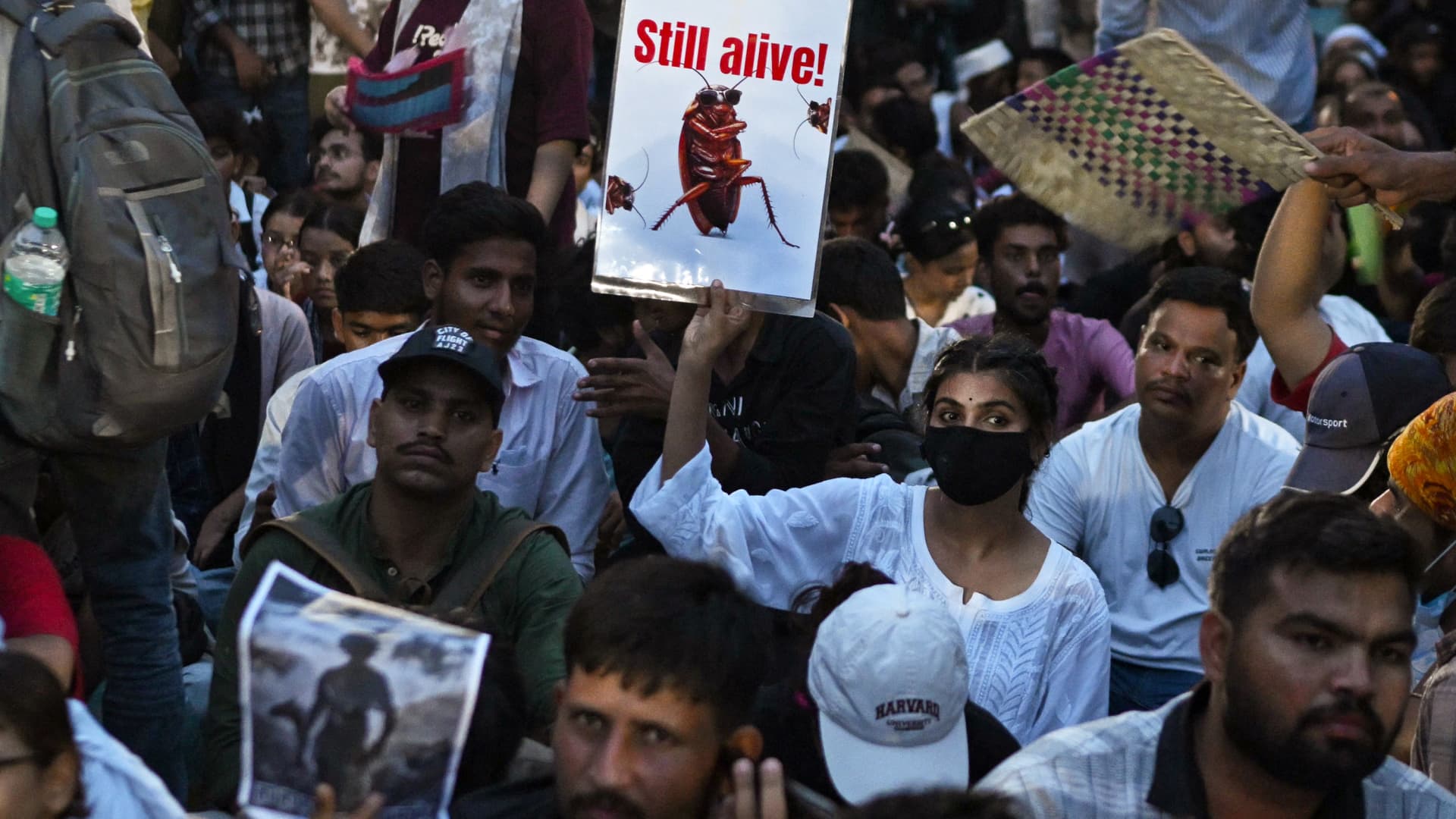
Thousands of student demonstrators led by the Cockroach Janta Party, known as CJP, have continued to gather in New Delhi, pressing for Education Minister Dharmendra Pradhan to resign over alleged exam paper leaks. The unrest has reached India’s parliament and comes as Verisk Maplecroft ranks India as the highest-risk country in its Civil Unrest Index.
The protests began on June 6, according to a demand posted by CJP on X, after allegations of leaks in major examinations in May. CNBC reported that the movement reflects broader anger among young Indians over unemployment and limited economic mobility in a country with one of the world’s largest youth populations.
Atman Trivedi, a partner at Washington-based DGA Albright Stonebridge Group, told CNBC the demonstrations may be the most significant public challenge to the government since the farmer protests of 2020 and 2021. Trivedi said CJP began as online political satire and has become a real-world protest movement.
The demonstrations escalated this week after students tried to march toward parliament from the protest site and crossed security barricades on Monday. CNBC reported that Delhi Police used tear gas and batons against protesters. Delhi Police said on X that more than 100 personnel were injured in what it described as violent protests.
Lavanya Singh, a 26-year-old who attended the July 20 protest, told CNBC that police appeared to use force to inflict damage rather than disperse the crowd. Singh said anger, betrayal and helplessness were driving students, and said she planned to keep attending the protest.
India’s home ministry did not respond to CNBC’s request for comment.
Political pressure rises
CJP was launched on May 16 by Abhijeet Dipke, a political communications strategist and Boston University student, after Chief Justice of India Surya Kant referred in court to people attacking institutions as “parasites” and likened some unemployed young people and activists to “cockroaches,” CNBC reported. The chief justice later said his oral observations had been misquoted, according to ANI.
The group has built a large online following, with CNBC reporting that it had more than 22 million followers before its account was taken down on Wednesday. Dipke blamed Prime Minister Narendra Modi in a post on X.
Opposition politicians have also increased pressure on the government. Rahul Gandhi, India’s leader of opposition, was briefly detained on Tuesday while holding a protest outside the prime minister’s residence in support of students, CNBC reported. Gandhi claimed in a broadcast on X that about 152 exam paper leaks had occurred in the past decade, affecting more than 75 million students.
The ruling Bharatiya Janata Party said the government would investigate Gandhi’s claims. Pradhan said on X on Wednesday that the government was “100% committed” to discussing the paper leak issue and addressing genuine concerns of young people in parliament. He also said students deserved certainty, solutions and responsibility rather than being used as props in a political campaign.
The National Eligibility cum Entrance Test, used for medical college admissions, was cancelled in May following paper leak allegations, affecting millions of students, CNBC reported. A retest was held in June.
Unrest spreads beyond Delhi
CJP said on X that protests were spreading across multiple Indian cities. In Bengaluru, 17-year-old student Angad Chabra told CNBC that frustration among students had become too high to remain silent, and that CJP had given young people a platform to rally.
Reema Bhattacharya, head of Asia research at Verisk Maplecroft, said in a Wednesday note that grievances in India are growing and average protest participation has more than doubled over the past year, with unrest now spread more widely across the country.
Farmers’ groups and regional political parties have also shown support for the student protests. Rakesh Tikait, a prominent farmers’ union leader, pledged support, according to a CJP post on X. Pramit Pal Chaudhuri, South Asia practice head at Eurasia Group, told CNBC the CJP was attracting a broad range of grievances against the government, while warning that this was making the movement increasingly chaotic.
This story draws on original reporting from CNBC.


