Trump AI data centers push meets widening oversight backlash
Trump urged officials to embrace AI data centers as faith, labor and local groups warn of costs, job risks and weak oversight.
By Marcus V. Thorne · Markets Editor
· 3 min read
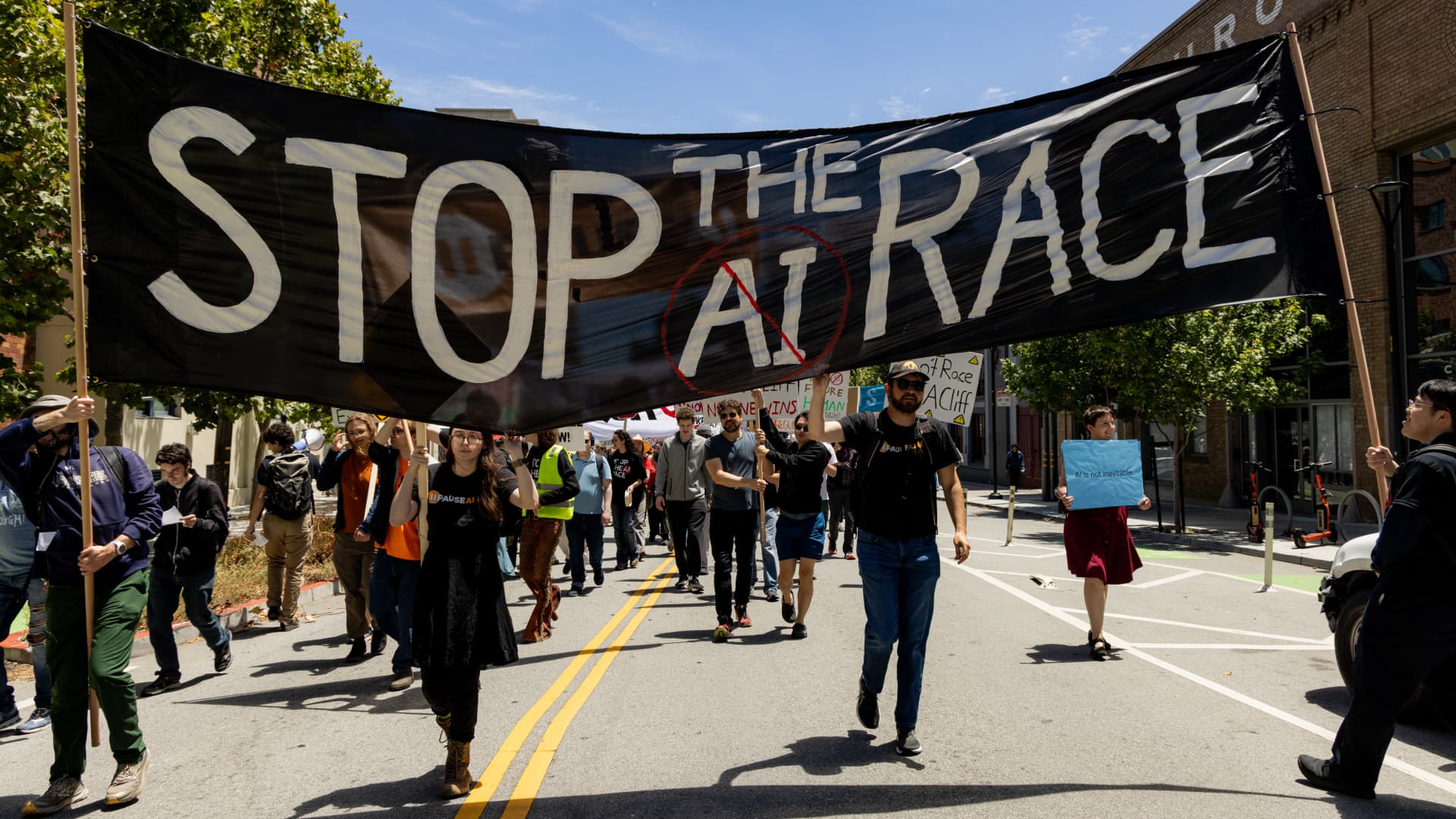
President Donald Trump’s push for AI data centers is running into a broader backlash from religious leaders, labor unions and local activists, CNBC reported, creating a political test as Republicans look toward the midterm elections. Trump on Thursday promoted commitments from data center developers and utilities not to increase electricity prices, seeking to address public concern that a building boom could push up household power bills.
Speaking at an Environmental Protection Agency event, Trump urged governors and local officials to support data center projects in their communities. “You can’t fight it. You have to go with it,” he said, according to CNBC. He also told officials that if they did not accept the investment tied to data centers, others would.
Data centers are large facilities that house computing equipment and networking systems. AI data centers require substantial electricity because advanced artificial intelligence models depend on dense clusters of servers and chips, making power supply, grid upgrades and local costs central to the debate.
Why are voters worried about AI data centers?
Opposition is being driven by concerns that AI infrastructure could raise electricity demand, strain aging grids and deliver most of the financial gains to technology companies and investors. CNBC reported that Trump highlighted promises by companies including OpenAI and Oracle, along with utilities, not to raise power prices, but the economics of grid investment could take years or decades to play out.
The issue is not confined to Democratic areas. New York Gov. Kathy Hochul has moved to impose a moratorium on data center construction, CNBC reported, but polling from the Yale Program on Climate Communication found resistance across party lines. In a June survey, 53% of conservative Republicans opposed local data center construction, along with 58% of registered voters and 74% of liberal Democrats.
The market backdrop has added to the political tension. CNBC noted that the Nasdaq Composite has recorded 20 record closes this year, reflecting investor enthusiasm around technology and AI. The same report said SpaceX shares were down 30% after its IPO last month, underscoring that public-market access does not necessarily translate into broad gains for retail investors.
Faith and labor leaders press for guardrails
Religious leaders have begun framing AI as a moral and social issue. Pope Leo XIV issued an encyclical in May warning that AI needed safeguards to protect human dignity, according to CNBC. Walter Kim, president of the National Association of Evangelicals, praised the pope’s warning in an appearance on CNBC’s “Squawk Box.”
“There are positive benefits, but there are also extraordinary harms,” Kim said. He raised concerns about AI’s role in health care, education and warfare, saying key human decisions risk being delegated to technology. Kim also described AI in language drawn from the pope’s encyclical as a “Tower of Babel,” reflecting what he called human hubris and disconnection.
Labor leaders are making a parallel argument focused on workers and political accountability. AFL-CIO President Liz Shuler told the federation’s convention last month that candidates seeking the presidency in 2028 should put “working people” before algorithms. Sean O’Brien, president of the International Brotherhood of Teamsters, said at an American Compass event with Palantir CEO Alex Karp that workers have not had “a seat at the table.”
Karp, who CNBC said grew up in a union household, told the same event that the biggest challenge to AI in the United States is political unrest. The convergence of faith groups, unions and local opponents gives the AI debate a constituency outside the technology sector, and CNBC reported that it could become a vulnerability for Republicans if voters view the boom as benefiting large tech companies more than households.
This story draws on original reporting from CNBC.


