Digital bank customers show stronger preference for mobile wallets
A PYMNTS Intelligence and Trustly survey found 44.6% of digital bank users prefer digital wallets, nearly double the share among U.S. consumers overall.
By Rafael Ortiz · Fintech Correspondent
· 3 min read
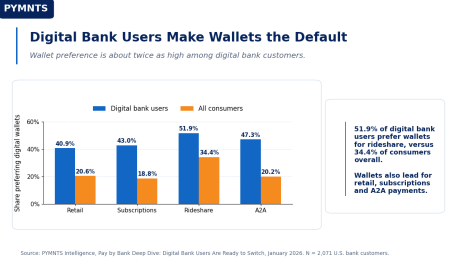
Digital bank customers in the U.S. are adopting mobile wallets at a materially higher rate than the broader banking public, according to a PYMNTS Intelligence report produced with Trustly. The survey of 2,071 U.S. bank customers found that 44.6% of digital bank users prefer digital wallets, compared with 22.7% of consumers overall.
The findings point to a payments segment that is already accustomed to mobile-first financial activity and may be more receptive to account-based payment products. PYMNTS Intelligence said digital bank users tend to be younger, more focused on mobile channels and more likely than other consumers to favor wallet-based payments.
Among digital bank customers, 40.9% said they prefer wallets for retail purchases. Debit cards remained a major alternative at 29.5%, while 18.9% preferred credit cards for retail transactions, according to the report.
Wallet use was strongest in categories that already rely heavily on app-based checkout. PYMNTS Intelligence found that 51.9% of digital bank users use wallets for rideshare payments, 43% prefer them for subscriptions and 37.7% choose them for groceries.
Where wallets are gaining share
The report said wallet preference among digital bank customers is not limited to one transaction type. Wallets led among these users for retail, subscriptions, rideshare, gambling and account-to-account payments. Debit retained an advantage for groceries and bills, while wallets still accounted for a substantial share of preference in both areas, according to PYMNTS Intelligence.
That behavior is relevant for banks, merchants and payment companies assessing Pay by Bank products. Pay by Bank allows a consumer to approve a purchase directly from a bank account through a digital checkout process, rather than routing the transaction through a card network. The model relies on customer authentication and account-linked authorization within a digital flow.
PYMNTS Intelligence said digital bank users’ familiarity with login-based checkout and tokenized credentials could lower the behavioral hurdle for Pay by Bank adoption. The report did not say adoption is assured, but it identified this group as more prepared than the broader population to consider direct bank-account payments.
Incentives could affect adoption
The survey found that financial benefits and protections could influence how much payment volume digital bank customers would shift to Pay by Bank. With discounts and buyer protection included, respondents said they could move as much as 35.4% of account-to-account transactions to Pay by Bank, according to PYMNTS Intelligence.
They also said they could shift 32% of bill payments, 28.8% of gambling transactions and 27.3% of rideshare purchases under those conditions. Immediate cash benefits were the leading incentive, cited by 43.1% of digital bank users. Buyer protection was cited by 16.9%.
More broadly, the report found that 69% of digital bank customers already regard Pay by Bank as a possible substitute for debit, or would do so if rewards, buyer protection or both were offered.
For payment providers, the data describe a customer base that already conducts a significant share of financial activity through mobile devices. PYMNTS Intelligence said adoption would depend on a straightforward user experience, clear protections and visible financial value.
This story draws on original reporting from PYMNTS.