Robotics firms target costly doorstep gap in delivery automation
Boston Dynamics, Amazon and Serve Robotics are testing machines aimed at reducing a delivery leg that industry estimates put at more than half of supply-chain costs.
By Rafael Ortiz · Fintech Correspondent
· 3 min read
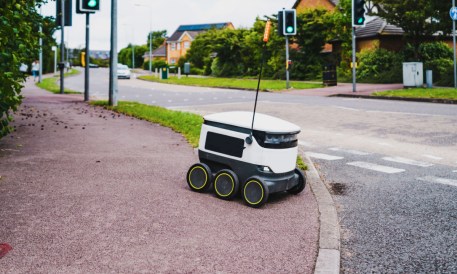
Delivery groups and robotics companies are focusing investment on the short trip from curb to doorstep, a segment that remains labour-intensive even as warehouses, routing and transport networks become more automated. Industry estimates cited by Boston Dynamics put annual US carrier spending on last-mile delivery at about $90 billion, with that stage accounting for more than half of total supply-chain costs.
The commercial challenge is concentrated in the final approach to a home: driveways, steps, gravel, ice and door placement. Boston Dynamics says its four-legged Spot robot is being tested as a delivery assistant that rides in a van, receives parcels from a driver and carries them to the customer’s door.
Marco da Silva, vice-president and general manager for Spot at Boston Dynamics, said the company views “the final frontier of logistics automation” as “that last 50 feet”. In the company’s test configuration, a driver loads packages on to a conveyor payload mounted on Spot’s back. The robot then moves across uneven ground and stairs before placing each item down.
Boston Dynamics has demonstrated the system by delivering a carton of eggs, citing the exercise as evidence of handling precision. The company’s stated pilot target is for Spot to work with one driver on 200 deliveries a day, five days a week. The Next Web has reported that Spot costs about $75,000.
Sidewalk robots have reached greater scale
Serve Robotics illustrates the progress made where terrain is more predictable. The company announced that it had deployed more than 2,000 autonomous sidewalk delivery robots by the end of 2025, describing the network as the largest sidewalk delivery fleet in the US.
Serve said its fleet expanded twentyfold in a year through partnerships with Uber Eats and DoorDash in Los Angeles, Atlanta, Dallas-Fort Worth, Miami, Chicago and Alexandria, Virginia. The company says its robots operate at Level 4 autonomy, meaning they can run without a human safety driver in defined conditions, and complete 99.8 per cent of deliveries.
That model has limits. Serve’s robots do not climb stairs. DoorDash’s Dot robot, which The Next Web reported has been deployed in Arizona since late 2025, can fit through doorframes but also cannot climb stairs. The available evidence shows commercial deployment on sidewalks has moved faster than automation of the doorstep hand-off.
Amazon and Boston Dynamics pursue stair-climbing systems
Amazon acquired Rivr, a Zurich-based robotics start-up, in March 2026 and plans to test its four-legged wheeled robots to help delivery associates bring packages to doorsteps, CNBC reported. TechCrunch reported that Rivr’s machines can climb stairs and travel over uneven surfaces, unlike Amazon’s earlier Scout sidewalk robot, which the company shut down in 2022.
TechCrunch reported that Rivr had raised $25 million in total funding and was last valued at about $100 million. CNBC reported that Amazon had previously invested in Rivr through its $1 billion Industrial Innovation Fund.
The competing designs reflect different engineering choices. Spot walks on four legs, a configuration intended for irregular terrain. Rivr combines wheels and legs, using wheels for faster movement on flat surfaces while retaining stair-climbing capability. Paige Miller, Spot’s product manager at Boston Dynamics, said drone delivery trials have struggled to reach porches and wheeled robots have faced constraints in last-mile use.
The economics remain unproven at scale. For operators, the question is whether a robot’s capital cost, maintenance needs and operating constraints can be offset by enough completed deliveries per route. PYMNTS reported that Nvidia chief executive Jensen Huang said at CES in January 2026 that robotics had reached its “ChatGPT moment”. The companies now testing delivery robots are seeking the operational data and utilisation rates needed to turn that claim into a commercial system.
This story draws on original reporting from PYMNTS.