UPS q2 2026 earnings show profit growth despite lower package volume
UPS raised its 2026 outlook after U.S. volume fell 3.3% but domestic operating profit rose 21% on pricing, automation and mix.
By Rafael Ortiz · Fintech Correspondent
· 3 min read
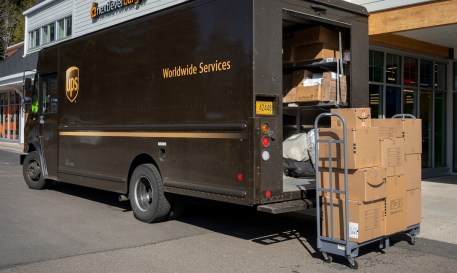
UPS q2 2026 earnings showed a smaller U.S. package base producing more profit, as domestic average daily volume fell 3.3% from a year earlier while U.S. revenue rose 6%. The company said domestic operating profit increased 21% and margin widened by 100 basis points, helped by a 9.3% increase in revenue per package, stronger pricing and a shift toward more attractive customer segments.
At the group level, UPS reported $22.8 billion in revenue, up 7.6%, and $2.1 billion in operating profit, up 12%, according to its Tuesday earnings materials. Management lifted its full-year outlook to about $91.2 billion in revenue, about $8.65 billion in operating profit and roughly $7.22 in diluted earnings per share.
Why did UPS package volume fall while profit rose?
UPS attributed the volume decline partly to the planned reduction of lower-yielding Amazon business. The company has been cutting less profitable parcels from its network while seeking more revenue from small and medium-sized businesses, healthcare logistics and business-to-business shipments.
That approach changes the role of scale in parcel delivery. A carrier can improve profitability if each package contributes more revenue, uses less labor and moves through facilities with lower unit costs. UPS said it eliminated about 2 million lower-quality Amazon packages per day and removed $4.5 billion in related expenses.
Chief Executive Carol Tomé told analysts on the earnings call that the company is pairing lower-return volume reductions with automation and better real-time information across its network.
How UPS is using RFID and AI in its network
UPS said it has deployed RFID sensing across U.S. delivery facilities and package cars, enabled RFID labeling at 5,500 UPS Store locations and started providing label printers to customers. RFID tags allow packages to be detected without a worker manually scanning each item, giving the company more frequent data on where parcels are moving.
The company is linking that RFID data to an artificial intelligence-powered digital twin of its operations. A digital twin is a software model of physical assets and flows, in this case facilities, package movements, vehicles, aircraft and transport modes. UPS said the system can help model how a disruption in one area, such as weather, facility capacity or transportation constraints, affects other parts of the network.
Tomé described RFID as the network’s “eyes and ears” and AI as its “brain.” UPS said the technology can remove hundreds of millions of manual scans a year. Tomé also told analysts the company has seen no customer churn where RFID is deployed at the point of origin.
Higher-value shipments drive the strategy
UPS said small and medium-sized business volume rose 4.3% year over year and accounted for 34.5% of U.S. volume in the quarter, up 250 basis points. Its Digital Access Program, which connects UPS with e-commerce platforms and shipping software, produced $1.4 billion in global quarterly revenue. B2B shipments made up 43.8% of U.S. volume.
Management also told analysts that 68.5% of U.S. package volume moved through automated buildings by the end of the second quarter, compared with 64% a year earlier. UPS said cost per package in an automated building is about 28% lower than in a nonautomated site.
Healthcare remains a major target for the company’s higher-value network. UPS said healthcare revenue exceeded $3 billion for a second consecutive quarter and that it added 27 temperature-controlled cross-dock facilities worldwide. Those sites are designed to move sensitive healthcare products between air and ground networks while preserving required temperature conditions.
UPS executives also described a high-end jeweler that switched from another carrier after adopting RFID capabilities. According to the company, RFID labeling at origin gave the jeweler automated visibility from pickup to delivery, reducing the need for guards to watch each manual scan.
The quarter’s results indicate that UPS is testing a different formula for parcel economics: fewer low-return packages, more automated handling and more data around each shipment. The company’s raised outlook shows management expects that mix to support earnings through the rest of the year.
This story draws on original reporting from PYMNTS.