US small businesses plan wider use of fintechs for overseas payments
PYMNTS Intelligence and Mastercard found 36% of surveyed internationally active U.S. SMBs expect to use fintechs for cross-border purchases in 2026.
By Rafael Ortiz · Fintech Correspondent
· 3 min read
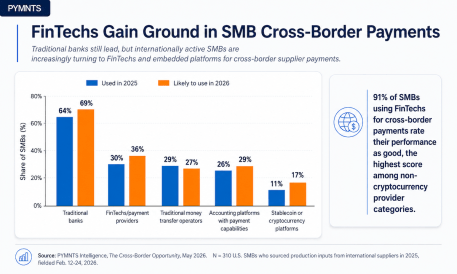
More U.S. small and medium-sized businesses that buy from overseas suppliers expect to use fintechs for cross-border payments in 2026, while banks are projected to retain the largest role. A PYMNTS Intelligence and Mastercard report found that 36% of surveyed internationally active SMBs plan to use fintechs or payment providers for international purchases in 2026, compared with 30% in 2025.
The findings come from “The Cross-Border Opportunity,” a report based on a survey of 310 U.S. SMBs that bought production inputs from international suppliers in 2025. The report indicates that smaller companies are adding specialist providers to handle international payment needs rather than replacing bank relationships outright.
Banks remain the main channel
Traditional banks continue to account for the widest usage among the businesses surveyed. PYMNTS Intelligence and Mastercard said 64% of internationally active SMBs used banks for cross-border supplier payments in 2025, and 69% expect to use them in 2026.
That increase suggests fintech adoption is developing alongside continued bank usage. A business may keep its core banking relationship while using another provider for certain suppliers, currencies or operational processes. In cross-border payments, the choice of provider can affect how quickly funds move, how foreign exchange is handled and how easily a company can track payment status.
The report said fintechs are gaining users faster and receiving stronger performance assessments. Among SMBs that use fintechs for international payments, 91% rated their performance as good, the highest result among provider categories outside cryptocurrency-focused platforms.
Digital tools shape provider choice
Fintech payment providers often combine payment initiation, foreign exchange functions and multicurrency account features in one digital interface. According to the report, those capabilities can make overseas transactions easier for SMBs to complete and monitor.
The mechanics can involve more than one layer. A fintech may provide the front-end experience for the business, while card networks or other financial infrastructure process or support the transaction. For SMBs, the visible benefit is usually operational: fewer manual steps, better tracking and tools that help manage payments across currencies.
Accounting platforms with payment capabilities are also expected to gain share. PYMNTS Intelligence and Mastercard found that 29% of surveyed SMBs expect to use those platforms for cross-border payments in 2026, up from 26% in 2025. Embedding payments into accounting software can link invoices, payment records and reconciliation in one workflow.
Competition remains broad
The report points to continued competition across provider types. Specialized money transfer operators are the only category projected to decline, with expected usage falling to 27% in 2026 from 29% in 2025.
Stablecoin and cryptocurrency platforms are expected to increase usage among the surveyed SMBs, rising to 17% in 2026 from 11% in 2025, according to the report. The report did not state that these platforms would overtake banks or fintech payment providers.
For banks, networks and payment companies, the findings point to a market in which service quality and integration may influence provider selection. PYMNTS Intelligence and Mastercard said SMBs appear willing to expand relationships with companies that make international payments faster, easier to track and simpler to manage.
This story draws on original reporting from PYMNTS.