Virtual cards working capital use differs sharply among middle-market firms
PYMNTS Intelligence says top middle-market performers are about five times likelier to view virtual cards as financing tools.
By Rafael Ortiz · Fintech Correspondent
· 3 min read
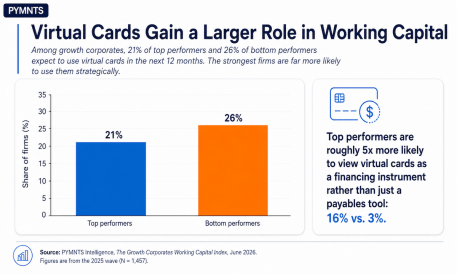
Virtual cards working capital use is becoming a clearer dividing line among middle-market companies, according to PYMNTS Intelligence. In a report covering three years of data from firms with $100 million to $1 billion in annual revenue, the research group found that 16% of top performers see virtual cards as a financing instrument, compared with 3% of bottom performers.
The finding points to a wider shift in corporate finance: virtual cards are being used not only to pay suppliers, but also to give finance chiefs more control over payment timing, visibility and short-term funding. PYMNTS Intelligence said the strongest growth companies tend to plan financing before it is needed, connect more suppliers to payment systems and move cash through the business more quickly.
The report, titled “The 24-Day Advantage: What Top-Performing CFOs Know About Working Capital,” frames virtual cards as one element of a broader working-capital system rather than a stand-alone fix.
How do virtual cards support working capital?
A virtual card is a digital payment credential that companies can use to settle supplier invoices without issuing a physical card. In a working-capital context, it can combine payment execution with financing flexibility by allowing a company to manage when cash leaves the business while maintaining a record of spending and supplier payments.
PYMNTS Intelligence said top performers are roughly five times as likely as bottom performers to recognize that role. The report does not suggest that virtual cards alone account for better cash conversion, but it presents them as part of a more deliberate approach to funding operations and growth.
Adoption interest is not limited to the strongest companies. According to the report, 21% of top performers said they were very or extremely likely to use virtual cards over the next 12 months. Among bottom performers, the share was higher at 26%, indicating broader interest even where the financing strategy may be less developed.
What separates top-performing finance teams?
The PYMNTS Intelligence data show a wide gap in cash conversion. Top-performing middle-market companies convert cash in 24.2 days, compared with 44.4 days for bottom performers.
The report also found differences in how companies use working capital. Stronger performers use it mainly to finance planned growth, while weaker firms rely on it more often in emergencies. That distinction matters because arranged funding can support investment without forcing a company to seek liquidity under pressure.
Top performers also showed broader interest in other financing tools. PYMNTS Intelligence said 29% expect to use corporate cards, compared with 23% of bottom performers. The strongest companies also expressed greater interest in working-capital loans and non-bank credit facilities, suggesting a more varied funding mix.
The report’s conclusion is measured: virtual cards will not erase the performance gap by themselves. PYMNTS Intelligence said they can contribute to a system built around predictable cash flow, more stable supplier links and financing arranged before liquidity needs become urgent.
This story draws on original reporting from PYMNTS.