Wire payments modernization faces $5.3 million Fedwire test
A PYMNTS Intelligence and Volante report says banks are upgrading wire systems as high-value transfers demand faster, safer routing.
By Rafael Ortiz · Fintech Correspondent
· 3 min read
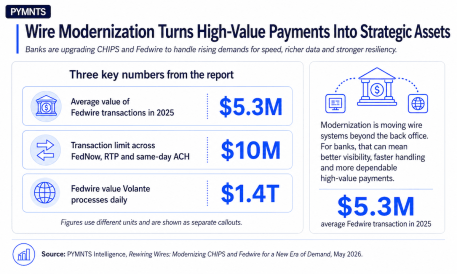
Wire payments modernization is becoming a higher priority for banks as the average Fedwire transaction reaches $5.3 million in 2025, according to a May report from PYMNTS Intelligence and Volante Technologies. The report says delays, processing errors and outages carry greater financial and operational consequences at that scale, while stronger monitoring and automation can improve how institutions handle high-value transfers.
The report, titled Rewiring Wires: Modernizing CHIPS and Fedwire for a New Era of Demand, says financial institutions are investing in the systems behind large and time-sensitive payments as corporate clients ask for quicker execution, richer transaction data and more dependable service.
PYMNTS Intelligence and Volante said upgraded platforms can help banks connect the Clearing House Interbank Payments System, known as CHIPS, and Fedwire with treasury applications and other payment networks. That integration can give banks a clearer view of payment flows and help them decide which route to use for a given transfer.
What is wire payments modernization?
Wire payments modernization refers to replacing or upgrading the technology banks use to send and manage high-value transfers, including Fedwire and CHIPS payments. The report describes modernization as a shift toward cloud-based processing, automated exception handling, application programming interfaces and systems able to use ISO 20022 payment data.
The pressure is not limited to traditional wire networks. PYMNTS Intelligence and Volante noted that the FedNow Service, the RTP network and same-day ACH now each support a $10 million transaction limit. Those higher limits bring more payment rails into consideration for urgent transfers and increase the need for banks to manage routing choices carefully.
Volante processes about $1.4 trillion in Fedwire payments each day, according to the report. That figure illustrates the operating burden on systems used by financial institutions and their clients for critical movement of funds.
How banks can use payment data
The report points to ISO 20022 as a central part of the shift. The messaging standard carries more structured payment information than older formats, which can help banks improve compliance screening, manage liquidity and give clients more visibility into transaction status.
Application programming interfaces can also link wire platforms to liquidity tools, treasury systems and broader payment networks, according to PYMNTS Intelligence and Volante. In practice, that means payment infrastructure can support decision-making rather than only execute instructions after they are entered.
The report also identifies constraints. Many banks still depend on older systems, manual workarounds and separate platforms for CHIPS and Fedwire. PYMNTS Intelligence and Volante said data conversion errors can delay payments, while business email compromise attacks remain a threat to high-value transfers.
The report says banks can address those risks by adopting cloud-based infrastructure, building systems that handle ISO 20022 data, distributing workloads across several cloud providers and using APIs to connect payment platforms. PYMNTS Intelligence and Volante said those steps can make wire payments more reliable and transparent while helping banks compete as faster payment options expand.
This story draws on original reporting from PYMNTS.