Apple hits record close as investors reassess its AI strategy
Apple’s 2026 gain has outpaced the Magnificent Seven as Wall Street gives more credit to its lower-cost approach to artificial intelligence.
By Marcus V. Thorne · Markets Editor
· 3 min read
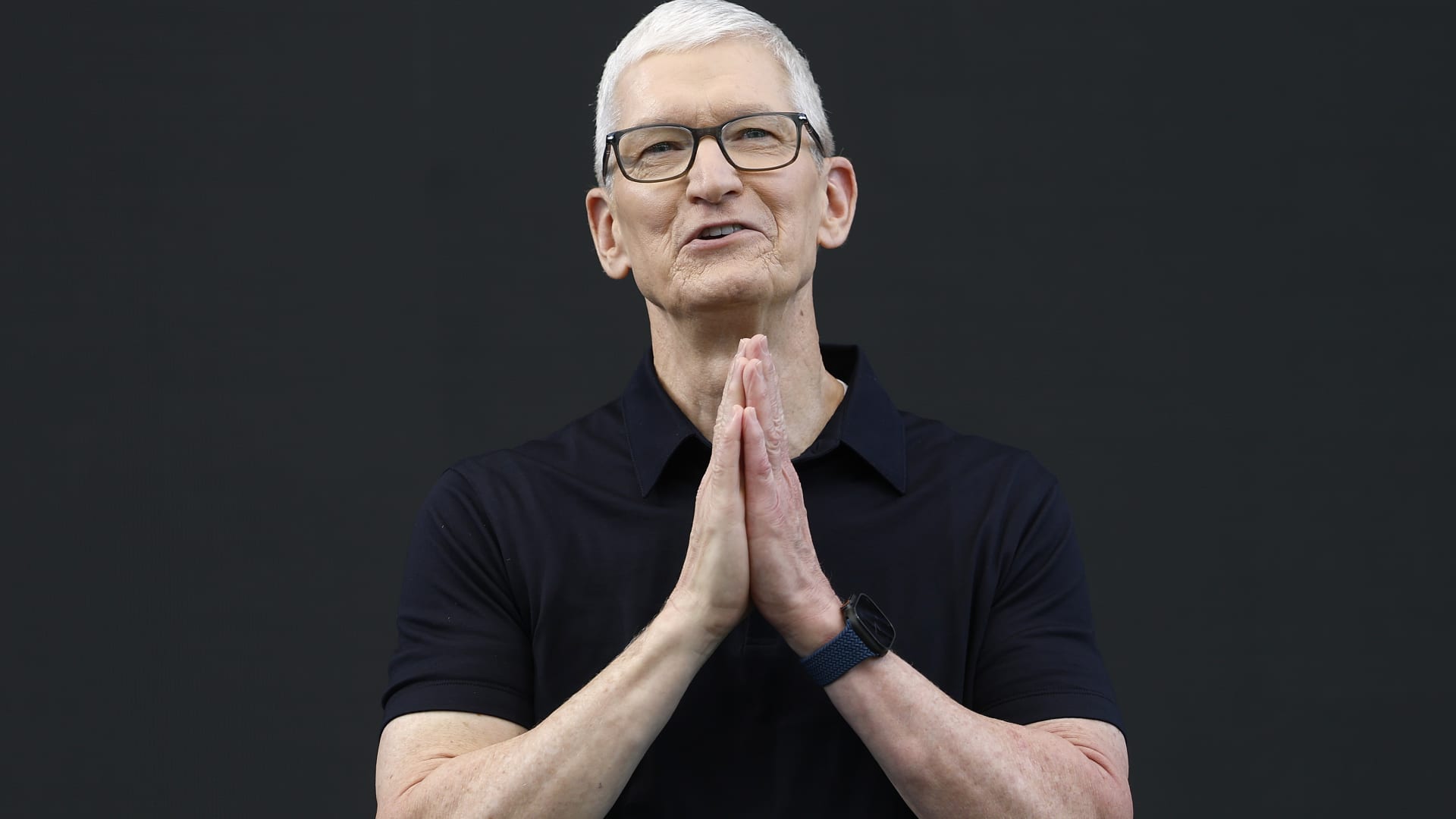
Apple shares reached their first record closing high in more than a month on Thursday, according to CNBC, extending a 2026 advance of about 16.5% despite a modest retreat on Friday. That performance has separated Apple from the rest of the Magnificent Seven, whose other members remain below their all-time closing highs.
CNBC reported that Amazon, Alphabet, Microsoft, Nvidia, Meta and Tesla are all trading below their peaks. Microsoft, Meta and Tesla set their closing highs last year, while Amazon, Alphabet and Nvidia reached highs on separate days in May before pulling back. Only Microsoft and Tesla are negative for 2026 among the group, CNBC said.
The market shift reflects a reassessment of Apple’s position in artificial intelligence, according to CNBC’s Investing Club. Investors had previously questioned whether Apple was too slow to respond after OpenAI released ChatGPT on Nov. 30, 2022, an event that accelerated spending by Amazon, Alphabet, Meta and Microsoft on computing capacity, data centers and AI products.
That spending benefited Nvidia, whose AI chips and networking equipment became central to the buildout. Apple lacked a cloud-computing business exposed to rising AI demand and did not have a leading large language model comparable to those used by OpenAI, Anthropic, Google or Meta, CNBC noted.
Apple’s AI path turns toward devices
Apple introduced Apple Intelligence at its Worldwide Developers Conference on June 10, 2024, but CNBC’s Investing Club described the subsequent release as rushed and uneven. The company offered fewer new AI software features in 2025, a year that also included tariff-related obstacles unrelated to AI.
Its stronger point, according to CNBC, was hardware. The iPhone 17, announced on Sept. 19, 2025, helped demonstrate the scale of Apple’s installed base, with the company able to distribute AI features through devices already used by consumers. CNBC cited about 1.5 billion iPhones in use globally.
A later development was Apple’s work with Google. CNBC said Google confirmed in January that it had reached a deal for Apple to license Gemini models and cloud technology. The arrangement, reportedly worth $1 billion a year, allows Apple to build on Gemini for its own models and an upgraded Siri, CNBC reported.
Apple showed a revised AI suite and a new Siri at WWDC on June 8, 2026. The improved Apple Intelligence rollout is scheduled for the fall, alongside new operating systems for iPhones, Macs, iPads and the Apple Watch, according to CNBC.
Lower spending becomes a market argument
CNBC’s Investing Club said Wall Street has become more willing to value Apple’s approach because the company has avoided the same large-scale model-development race as some peers. In that view, Apple is aiming to provide widely used AI-capable devices while relying on partners for core model infrastructure.
The mechanism matters for investors. A token is a basic unit used in AI computing, and heavy use of advanced models can raise infrastructure costs. CNBC said companies and consumers are increasingly focused on token optimization, meaning they may choose models that are good enough for a task rather than the most advanced and expensive option available.
That trend could fit Apple’s strategy if the company combines a non-frontier model with personal data stored on a user’s iPhone, CNBC’s Investing Club argued. The analysis said such a model could be useful without requiring Apple to release new large language models as frequently as OpenAI, Anthropic, Google or Meta.
Apple still faces questions on execution and input costs. CNBC identified rising memory prices as a headwind for Apple and for other technology companies buying memory for AI chips. The analysis said Apple may be better positioned than some peers because it sells premium products to higher-income consumers and can use pricing to protect margins, including through carrier subsidies.
The next test for pricing will be the iPhone, with more details expected at Apple’s annual fall launch event, CNBC said.
This story draws on original reporting from CNBC.