Boeing stock upgrade follows stronger cash flow in second quarter
CNBC’s Investing Club raised Boeing to a buy-equivalent rating after second-quarter free cash flow beat expectations.
By Sarah Jenkins · Chief Macro Economics Correspondent
· 3 min read
CNBC’s Investing Club issued a Boeing stock upgrade on Tuesday after the aircraft maker reported second-quarter revenue above Wall Street expectations and free cash flow that was stronger than analysts had projected. Boeing shares rose more than 4% in late morning trading as investors weighed evidence of progress under Chief Executive Kelly Ortberg against another charge in the company’s defense business.
Boeing said second-quarter revenue increased 8% from a year earlier to $24.56 billion. That exceeded the $24.25 billion consensus estimate compiled by LSEG, according to CNBC. Adjusted earnings showed a loss of 76 cents a share, wider than the 30-cent loss analysts expected, LSEG data showed.
The main positive surprise was cash generation. Boeing reported free cash flow of $631 million, compared with the $177 million cash burn expected by analysts in FactSet data, according to CNBC. Free cash flow measures cash left after capital spending and is closely watched at Boeing because aircraft deliveries generate large customer payments.
Why did CNBC upgrade Boeing stock?
CNBC’s Investing Club said the cash-flow result strengthened its view that Ortberg’s turnaround is taking hold, and raised its rating on Boeing to a buy-equivalent 1 while keeping a $275 price target. Jim Cramer said on CNBC’s Morning Meeting that Boeing’s second-quarter cash performance supported the club’s more constructive view.
The upgrade came as Boeing works to recover production stability after years of safety and quality problems. Ortberg took over in August 2024, after U.S. regulators had limited output of the 737 Max following the Alaska Airlines door-plug incident in January 2024.
The Federal Aviation Administration has since allowed Boeing to lift 737 Max production in stages, according to CNBC. The regulator raised the monthly cap from 38 to 42 in October and then to 47 in late May. Ortberg said on the earnings call that Boeing has begun moving toward 47 aircraft a month and expects factory rollouts to reach that pace this summer.
Ortberg said early production-quality results were within Boeing’s expectations, citing improvements in factory health. He also said he was not seeing supply-chain issues that would cause him to be “overly concerned” about a later increase to 52 aircraft a month, though he said reaching 57 and higher would become harder.
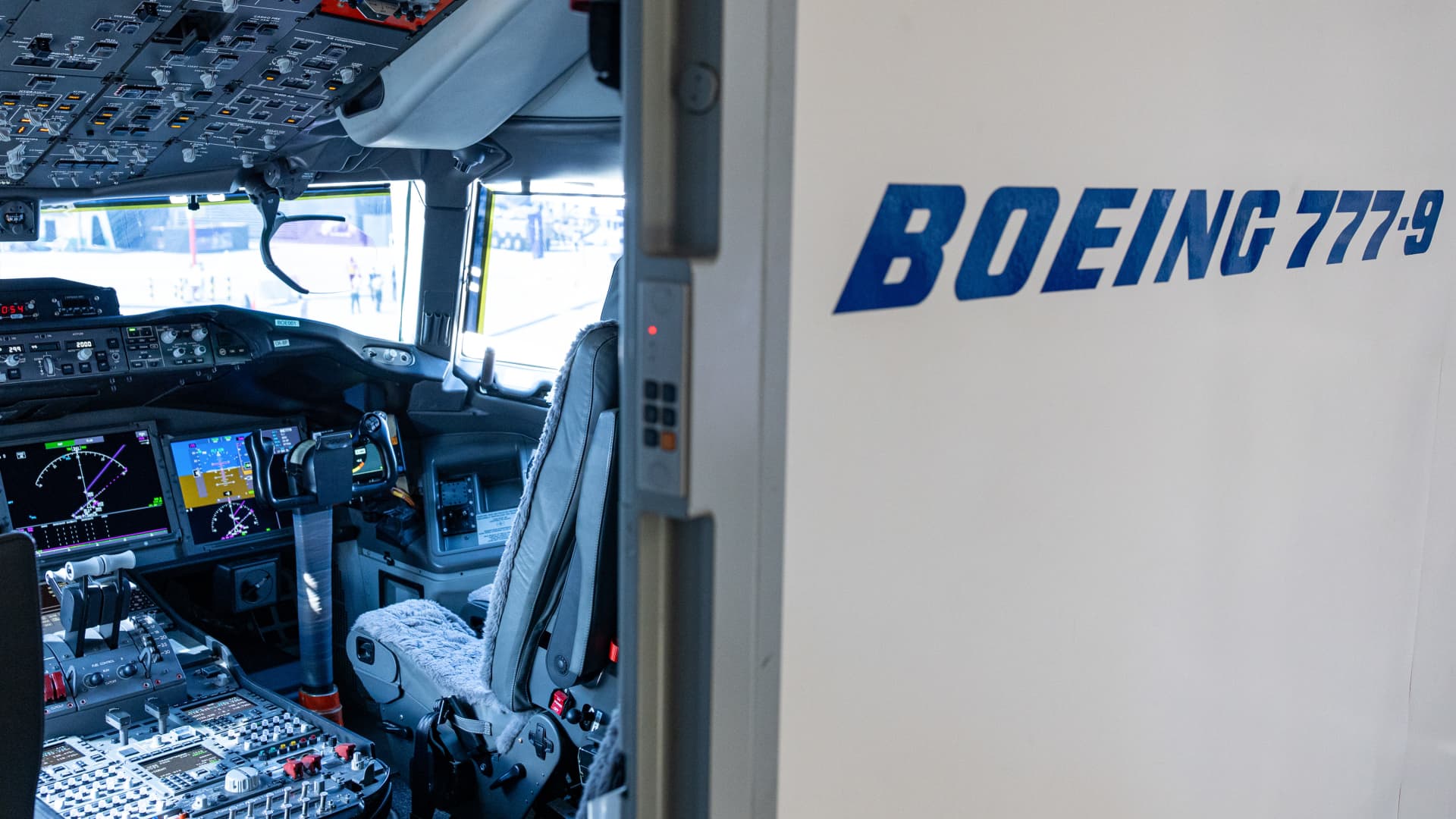
Boeing also continues to await certification of additional aircraft variants. Ortberg said FAA approval for the 737 Max 7 is expected “very soon,” with Max 10 approval expected after that. He said those approvals would support deliveries beginning in 2027. Boeing also said the 777X remains on track for first delivery next year after the FAA moved the jet into a later phase of test flights during the quarter.
The company reiterated expectations for 500 aircraft deliveries in 2026 and full-year free cash flow of $1 billion to $3 billion. Chief Financial Officer Jay Malave said reaching $10 billion in free cash flow was “very attainable,” according to CNBC, which also cited Wall Street expectations for that level in 2028.
The defense and space division remained a drag. Boeing recorded a $280 million charge tied to the VC-25B program, the replacement aircraft for Air Force One. Ortberg called the charge disappointing but said Boeing added resources to support the build and test schedule and meet its commitment to deliver the aircraft in 2028.
Boeing’s shares had been volatile before the results, with CNBC citing pressure from oil-price swings and Middle East instability linked to the Iran war that began on Feb. 28. As of Monday’s close, the stock was about 16% below its 2026 high close of $252.15 on Jan. 23.
This story draws on original reporting from CNBC.