China DUV machine report weighs on ASML, but analysts see limits
ASML shares fell after a report on a China DUV machine, though analysts cited yield, scale and export-control constraints.
By Marcus V. Thorne · Markets Editor
· 4 min read
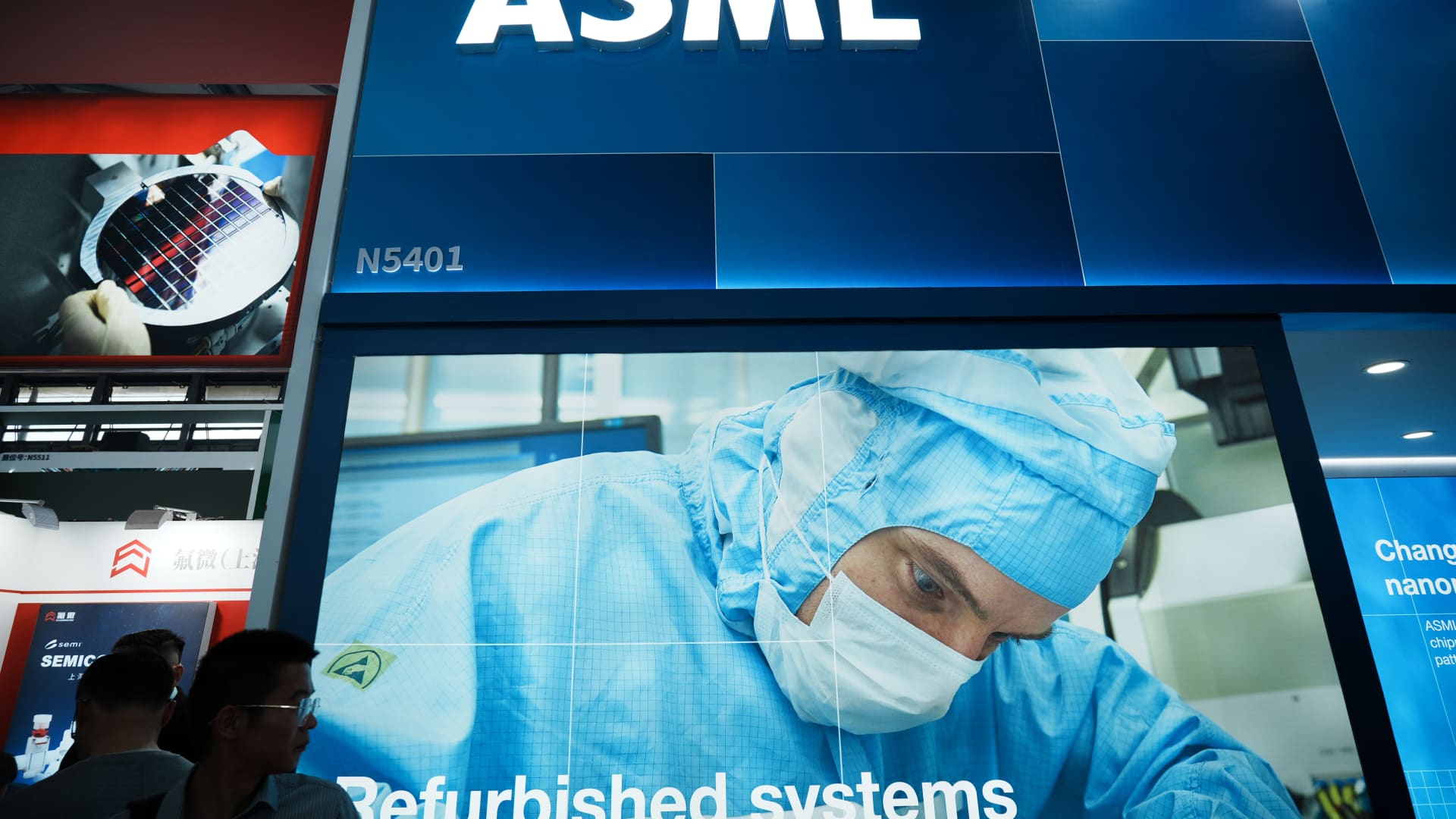
ASML shares fell on Tuesday after a report that a China DUV machine is entering production, putting investor focus on a chipmaking market long led by the Dutch supplier. The move came during a broader sell-off in semiconductor stocks, with ASML last down 1.8% on the day while still up more than 123% for the year, according to CNBC.
The Information reported on Monday, citing people familiar with the matter, that an unnamed Chinese company has started making an immersion deep ultraviolet lithography machine. The report said the tools are expected to go this year to major Chinese chipmakers, including Semiconductor Manufacturing International Corp. and Changxin Memory Technologies, which made its market debut this week.
Lithography systems are central to semiconductor production because they print circuit patterns onto silicon wafers. Immersion DUV tools are used for less advanced chips, while extreme ultraviolet lithography machines are used to manufacture the most advanced processors, including chips designed by companies such as Apple and Nvidia.
ASML dominates both DUV and EUV lithography. That position has made any sign of domestic Chinese progress in lithography a market-sensitive issue, particularly as Beijing seeks to reduce reliance on foreign semiconductor equipment amid export restrictions.
Will China’s DUV machine hurt ASML?
Analysts interviewed by CNBC said the reported development is unlikely to displace ASML in a significant way in the near term. Stephane Houri, head of equity research at ODDO BHF, told CNBC that the Chinese system may be confined to the low end of the market and said the report should be treated cautiously.
One constraint is manufacturing performance. Chipmakers measure lithography tools in part by yield, meaning the share of chips produced that can be used or sold. Nick Patience, AI lead at the Futurum Group, told CNBC that China would need to achieve yield parity with existing equipment, rather than demonstrate a tool that merely works.
Patience said the imported DUV systems used by SMIC already deliver weaker performance than those used by Taiwan Semiconductor Manufacturing Co. He added that any machine from an unknown state-backed Chinese company would start from a lower base, and that reliability requires years of use and improvement in operating fabs.
Production scale is another issue. The Information reported that the Chinese developer aims to build five DUV units this year and roughly 20 in 2027. ASML has said it is planning capacity for about 130 DUV immersion machines in 2026, with a further 30% increase planned for 2027.
SemiAnalysis analysts told CNBC that China faces multiple obstacles, including tool performance, production scale, fleet reliability, the surrounding supplier ecosystem and weak economics against older ASML machines that customers have already depreciated. The analysts said scaling production of the tool itself is an underestimated challenge.
China represented 14% of ASML’s 6.6 billion euros in second-quarter net system sales, equal to about 924 million euros, according to CNBC’s figures. But SemiAnalysis said Chinese DUV systems would replace revenue ASML has already lost because export controls restrict some sales of immersion DUV equipment to Chinese customers.
Paul Triolo, a partner at DGA Albright Stonebridge Group, told CNBC that a real challenge to ASML would require the Chinese company to produce reliable machines repeatedly and support them across different chip fabrication plants globally. He said supplying a small number of domestic tools is materially different from competing with ASML’s worldwide installed base.
Does DUV progress mean China can build EUV tools?
Reuters reported last year that China had completed a working prototype of an EUV machine. Analysts cited by CNBC said advances in DUV do not automatically translate into commercial EUV capability because EUV uses more complex light-source and optics technology.
SemiAnalysis said ASML required roughly two decades and about $10 billion in research and development and co-investment from Intel, TSMC and Samsung to make EUV commercially viable, with profitability at scale emerging around 2018 to 2019. Houri told CNBC that EUV remains a different technology and is out of reach for China at present, while acknowledging the difficulty of ruling out future progress.
This story draws on original reporting from CNBC.