Gold and silver rebound as analysts question durability of rally
Spot silver and gold rose this week after recent selling, though major banks say rates, the dollar and positioning may limit further gains.
By Amanda Ross · Deals Correspondent
· 3 min read
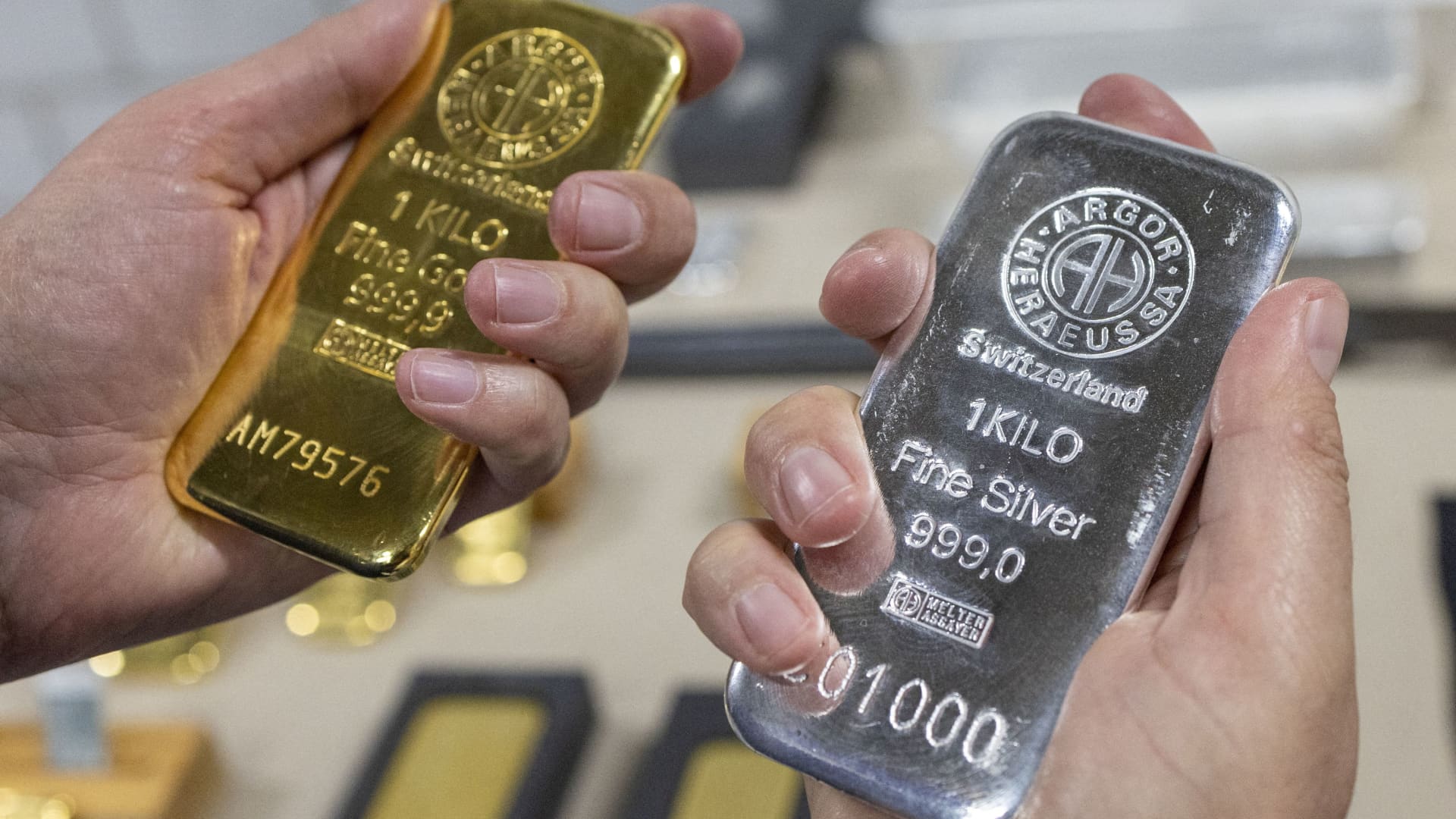
Spot silver climbed about 6.3% from the end of last week to $59.47 an ounce in early Wednesday trading, while spot gold was up about 2.4% over the same period at $4,119.04 an ounce, according to CNBC market data. The advance offered some relief after a period of selling, but analysts at ING, Bank of America and UBS said the metals still face obstacles to regaining the records reached in January.
ING commodities strategists Warren Patterson and Ewa Manthey said in a Wednesday note that the latest move looked more like bargain buying after price weakness than evidence of a changed geopolitical or macroeconomic backdrop. Gold and silver remain far below their late-January peaks, when spot gold reached $5,589.38 an ounce and silver touched $121.67 an ounce, according to CNBC.
The pressure on precious metals has come from higher interest rates and a stronger U.S. dollar, CNBC reported. Higher rates can make non-yielding assets such as gold and silver less attractive relative to cash or bonds, while a firmer dollar can weigh on dollar-priced commodities by raising their cost for buyers using other currencies.
Rates, energy and the dollar frame the trade
Patterson and Manthey said Middle East tensions still provide support for precious metals, while investors are balancing weaker U.S. economic data against inflation risks linked to higher energy prices. They said gold is likely to stay sensitive to energy market developments and expectations for U.S. monetary policy.
Silver may have a different path because it is used both as a store of value and in industrial applications. ING said the metal could perform better than gold if industrial metals remain strong while investors continue to seek havens. The bank pointed in particular to improving sentiment around copper as a supportive factor for silver.
Bank of America analysts were more cautious on gold after the metal posted its weakest quarter in 13 years in the three months through June, according to CNBC. In a July 16 note, BofA cited a death cross signal, high net-long positioning and similarities with previous major peaks as factors that raise the risk of a longer and deeper pullback.
A death cross is a technical chart pattern in which a shorter-term moving average, often the 50-day average, falls below a longer-term moving average, commonly the 200-day average. Traders use the pattern as one measure of weakening momentum, though it does not by itself determine future prices.
UBS lowers its preferred silver entry range
UBS also expressed caution on silver this week. The Swiss bank cut the level it considers an attractive entry point for silver to a range of $48 to $50 an ounce, from about $55 an ounce previously.
Dominic Schnider, a UBS strategist, wrote in a July 20 note that silver still faces near-term headwinds from rising Middle East tensions, higher opportunity costs and a firm U.S. dollar. He said the broader backdrop gives investors little reason to add long positions, and that uneven investment demand means silver has not yet established a firm price floor.
Some industry executives remain more constructive. Diane Garrett, executive chair and chief executive of U.S.-based gold and silver developer Hycroft Mining, told CNBC’s “Squawk Box Europe” on Tuesday that the recent decline is a normal correction and said the bull market has not broken.
Garrett said commodity fundamentals remain strong, especially for gold, and argued that investors are increasingly reluctant to hold hard assets backed by another country’s debt. She also cited 17 consecutive months of central bank buying. On silver, she said demand is supported by its monetary role and by industrial uses tied to artificial intelligence infrastructure and supercomputing, where she said there is no substitute.
This story draws on original reporting from CNBC.