Kospi Nasdaq correlation climbs as AI chip trade links Seoul and Wall Street
Rayliant data show the Kospi and Nasdaq 100 moving more closely as Samsung and SK Hynix tie Korea’s market to AI spending.
By Sarah Jenkins · Chief Macro Economics Correspondent
· 3 min read
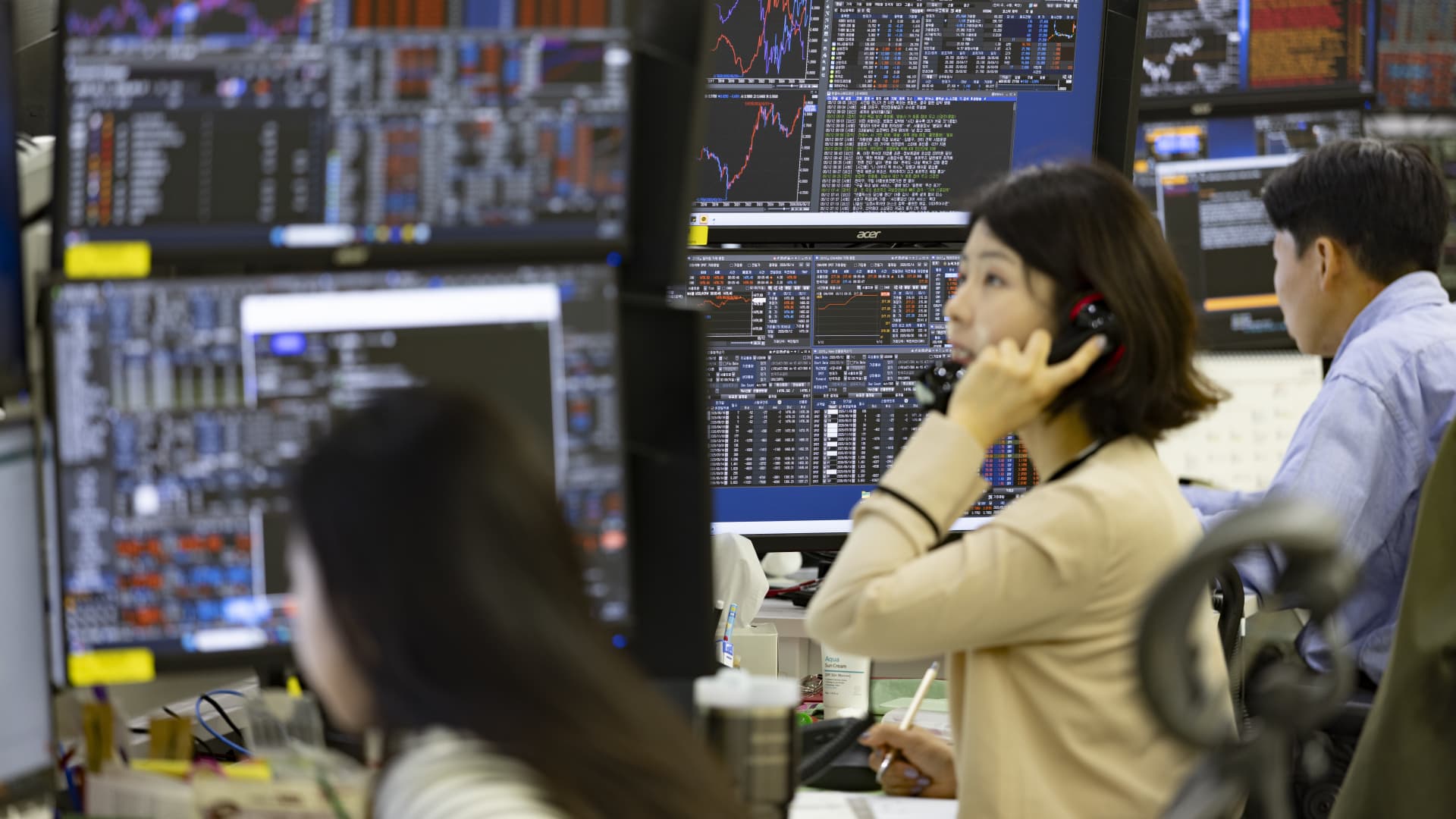
The Kospi Nasdaq correlation has risen to its strongest level since 2021 as investors increasingly price South Korean equities through the same artificial intelligence cycle driving Wall Street technology shares. Rayliant data cited by CNBC show the 60-day correlation between the Kospi and Nasdaq 100 recently reached about 0.50, reflecting the growing market weight of Samsung Electronics and SK Hynix.
The link has tightened because Korea’s benchmark index is heavily exposed to memory chips used in AI data centres. Samsung and SK Hynix together account for more than half of the Kospi, and both supply memory components to the global AI hardware chain.
Rolf Bulk, an analyst at Futurum Group, told CNBC that the Kospi has increasingly come to resemble a semiconductor index. He said data-centre demand has risen from about 40% of global DRAM demand last year to more than half this year, with further growth expected. DRAM, or dynamic random-access memory, is a core component in AI servers.
Why are the Kospi and Nasdaq moving together?
The common driver is spending by large U.S. cloud and technology companies on AI infrastructure. That spending supports demand for chips, servers and memory, linking the earnings outlook for U.S. technology groups with Korean suppliers such as Samsung and SK Hynix.
A positive correlation means two markets are tending to move in the same direction over the measured period. At about 0.50, the relationship is not one-for-one, but it is strong enough for analysts to warn that Korean equities may offer less diversification from U.S. technology risk than investors previously assumed.
Jung In Yun, founder of Fibonacci Asset Management, told CNBC that Samsung and SK Hynix can give investors the first liquid market reaction in Asia to overnight news affecting global AI demand. He said SK Hynix has become a notable barometer because of its exposure to high-bandwidth memory, a critical part of the AI supply chain.
Recent trading showed how quickly that signal can travel. On July 13, the Kospi dropped more than 8% as SK Hynix fell 15%. The Nasdaq 100 later closed 1.88% lower, while Micron Technology lost 4%, Sandisk declined 12% and Intel fell 6%.
Peter Kim, head of global investment strategy at KB Financial Group, told CNBC that the Korean memory-chip rally started later than the Nasdaq’s advance because U.S. investors first concentrated on hyperscalers. He said the size and volatility of the Korean rally have since led global investors to treat Korea as a bellwether for the broader AI trade.
Samsung’s earnings guidance also gives markets an early quarterly signal on AI-related demand, because the company typically reports about two weeks before major U.S. semiconductor companies.
What are the risks for investors?
Analysts cited by CNBC cautioned that Korean and U.S. technology shares are increasingly responding to the same factor: sentiment toward AI hardware. Phillip Wool, head of research at Rayliant Global Advisors, said neither market consistently leads the other. News released while U.S. markets are closed can show up first in Samsung and SK Hynix, while U.S. trading can foreshadow the next Korean session.
Bulk said Korea no longer provides the same diversification against U.S. technology exposure, given the Kospi’s concentration in one cyclical theme. He warned that a slowdown in hyperscaler capital expenditure would weigh on Korea more than many other markets, and added that leveraged exchange-traded fund flows can magnify swings in Korean memory stocks.
Kim said performance could diverge over time because Micron, Samsung and SK Hynix differ in capital spending, product mix and exposure to U.S. support for domestic chip production. He also identified China’s expansion into memory chips as an emerging risk, noting that Chinese producers remain behind global rivals technologically but have often advanced faster than investors expected.
This story draws on original reporting from CNBC.