Nvidia unveils Vera CPU details as AI server competition widens
Nvidia says its Vera CPU is built to keep AI GPUs busier, putting it into a server processor market led by AMD and Intel.
By Sarah Jenkins · Chief Macro Economics Correspondent
· 3 min read
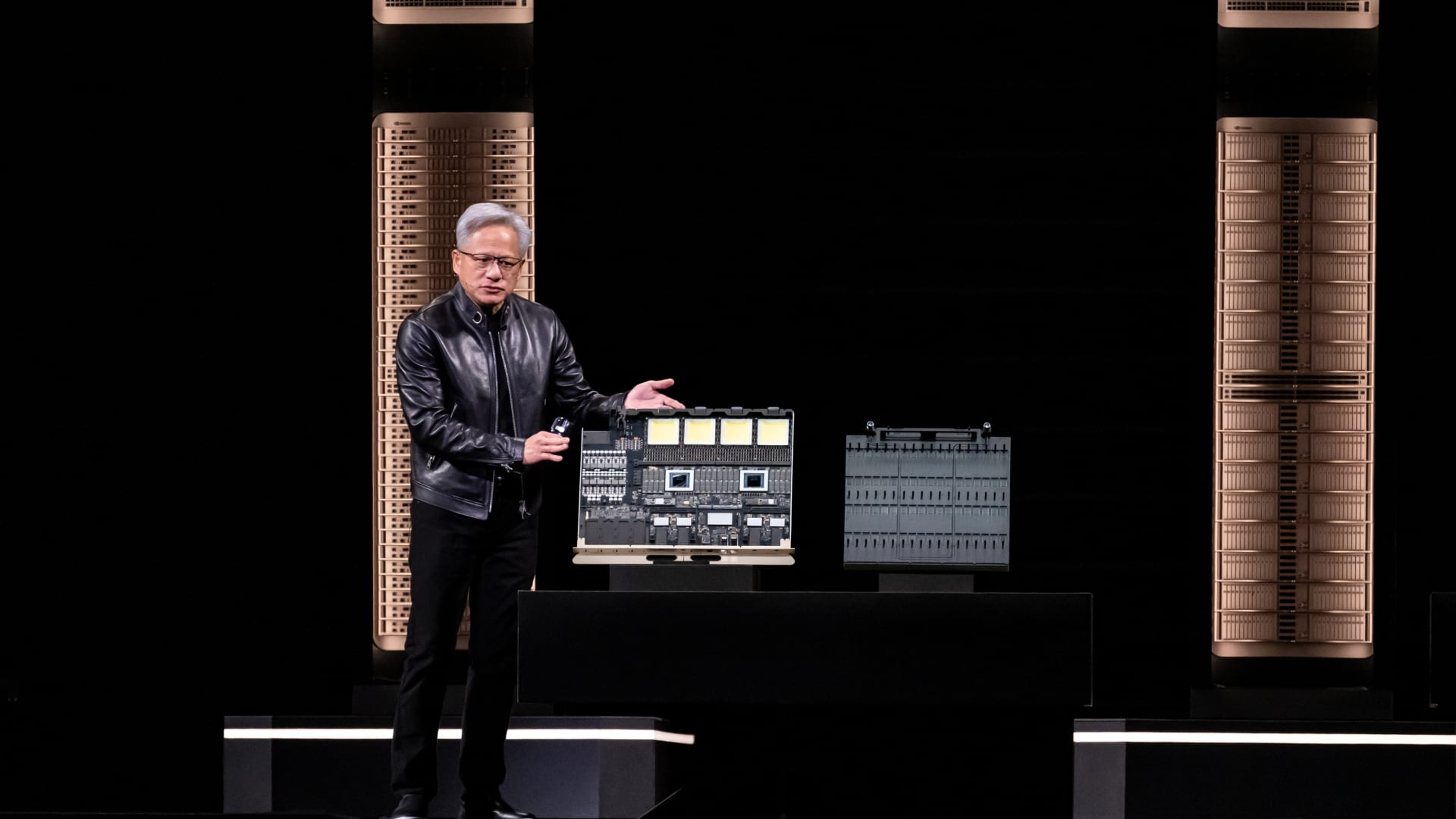
Nvidia has released detailed specifications for Vera, its data center central processing unit for artificial intelligence workloads, expanding its contest with AMD and Intel beyond graphics processors. The company said the chip is intended to improve AI server performance by moving data and instructions to GPUs faster, a priority as AI agents place new demands on server CPUs.
The disclosure gives potential buyers benchmarks and architecture details needed to assess the processor. Nvidia representatives said Vera chips were delivered in June to customers including OpenAI, Anthropic and SpaceX. The company also said OpenAI plans to deploy Vera chips in large volumes starting this quarter.
Nvidia’s rise to the top of global equity markets has been driven by demand for its graphics processing units, the dominant chips used to train and run AI models. Vera extends the company’s strategy of selling more complete computing systems, including full racks, rather than relying only on standalone GPU sales.
Why CPUs are gaining attention in AI servers
Before the current AI build-out, the CPU was typically the central and most costly processor in a server. Early AI systems around the launch of ChatGPT in 2022 often used as many as eight GPUs for each CPU, reflecting the shift in spending toward accelerators.
Nvidia executives said agentic AI has made the CPU more central again. These systems can operate with limited human direction, but they still require processors to manage tasks, handle prompts and feed data to GPUs. Ian Buck, Nvidia’s vice president of hyperscale, said at a presentation last week that CPUs have become “much more integral,” especially in determining how quickly a system can answer a request.
Nvidia said Vera has 50% better performance for AI agents than x86 chips, the architecture used by AMD and Intel. The company said the design emphasizes single-core speed, memory bandwidth and latency, rather than primarily increasing the number of cores.
Hannah Coutand, a Vera product marketer at Nvidia, said the objective is to return agents to the GPU as quickly as possible and keep those expensive processors highly used in what Nvidia calls an AI factory.
Market stakes and product configurations
Nvidia said the server CPU market could eventually reach $200 billion. Bernstein estimated earlier this year that the mature server CPU market was worth about $37 billion in 2025. Wolfe Research said in May that Vera could carry an average selling price of about $5,000 and projected shipments of roughly 1.3 million units this year. Nvidia declined to comment on pricing.
The equity market has reflected renewed investor interest in server CPU suppliers. CNBC cited year-to-date gains of 128% for AMD and 149% for Intel, compared with an 8% increase for Nvidia.
Gartner analyst Kevin Knox said AMD is the current company to beat in enterprise AI server CPUs. AMD reportedly holds about 33% of the server CPU market, while Intel has 66.8%, though AMD has been gaining share and has strong ties with hyperscale buyers. Knox said AMD has built a strong ecosystem around its processors.
Nvidia said Vera is the first server CPU it has designed from the core, rather than using an off-the-shelf Arm design. The chip will be sold separately, paired with Nvidia GPUs in the Vera Rubin system, used in a two-chip server configuration and offered in a liquid-cooled rack containing 256 Vera CPUs.
The processor uses between 250 watts and 450 watts of power and supports up to 1.5 terabytes of low-power memory per chip, the company said. Cambrian AI Research founder Karl Freund said Vera is likely to be used for demanding AI workloads rather than conventional server tasks such as serving websites.
Adoption by major cloud providers remains a test. Nvidia listed Oracle among cloud partners, while Coutand described Vera’s uptake as being in the early stages. Freund said Nvidia designed the CPU to reduce customer reliance on Intel and AMD processors, targeting revenue that those suppliers have long controlled.
This story draws on original reporting from CNBC.


