Pornainen sand battery expands Finland’s heat storage options
Finland’s Pornainen is using a 100 MWh sand battery to store renewable power as heat and cut district heating emissions.
By Amanda Ross · Deals Correspondent
· 3 min read
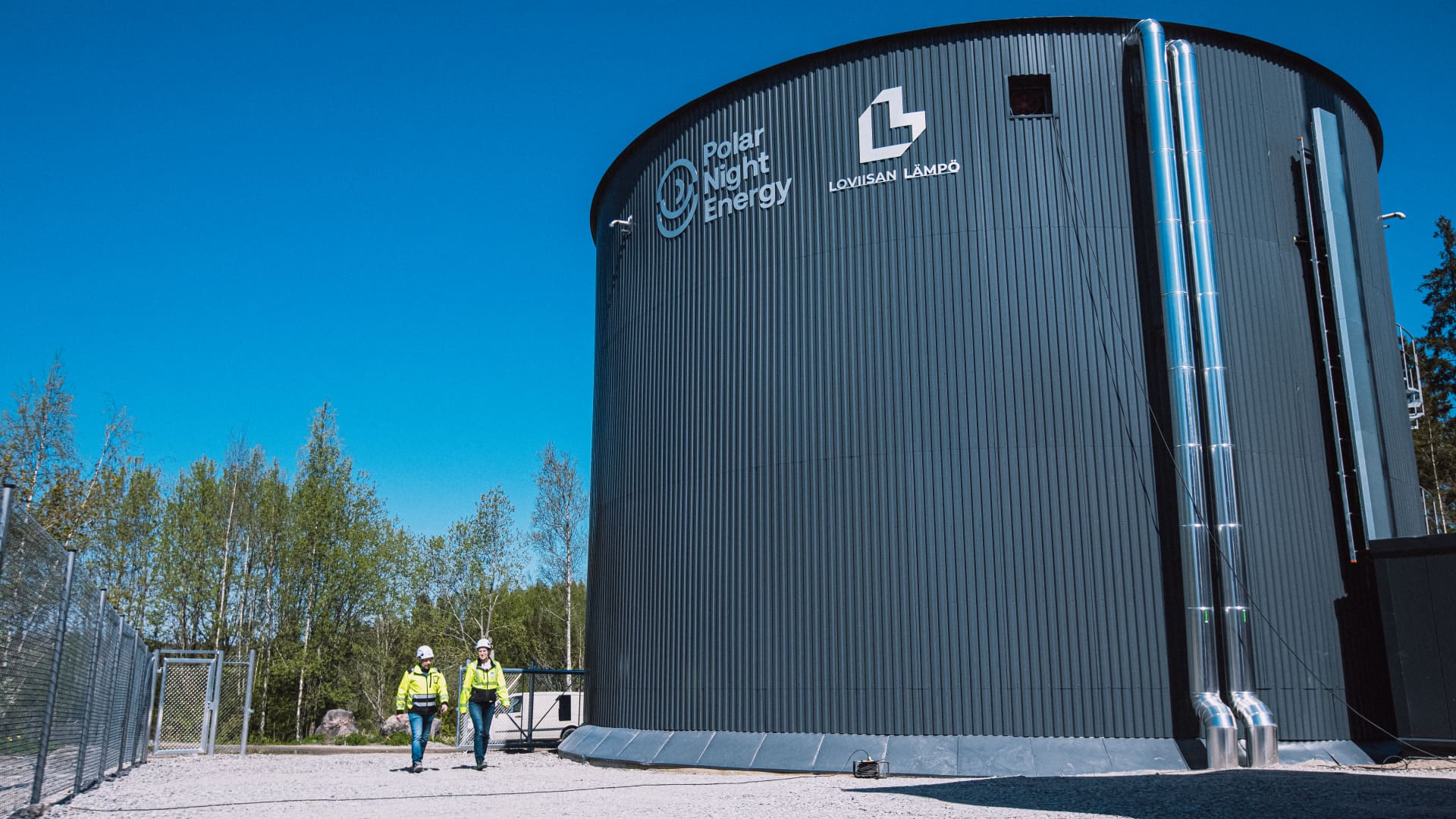
The Pornainen sand battery in southern Finland is now the world’s largest commercial sand battery, according to developer Polar Night Energy, giving the town a 100 megawatt-hour thermal store for district heating. The 13-meter-tall, 15-meter-wide facility can cover nearly a month of Pornainen’s heat demand in summer and about one week in winter, CNBC reported.
The project was commissioned by Finnish district heating company Loviisan Lämpö and developed by Polar Night Energy. It uses 2,000 metric tons of crushed soapstone to store electricity as heat, a design aimed at one of the main operational problems for wind and solar power: production rises and falls with the weather and time of day.
Polar Night Energy said the installation has cut greenhouse gas emissions from the local heating network by almost 70% and reduced wood-chip use by about 60%. The existing wood-chip plant remains available for backup and peak-load demand.
Tommi Eronen, Polar Night Energy’s chief executive, told CNBC that Pornainen had relied on oil and wood chips for heating, while the sand battery can now supply combustion-free heat for most of the year. He said the shift toward wind and solar generation requires “a massive amount of storage” and added that sand-based systems could provide some of that capacity without rare earth materials used in many chemical batteries.
How does the Pornainen sand battery work?
A sand battery is a heat-storage system: it uses electricity to raise the temperature of a solid material, then releases that heat later. In Pornainen, surplus or low-cost grid electricity, including periods of strong wind or solar output, heats the crushed soapstone inside a heavily insulated silo.
The insulation allows the stored heat to remain available for days or weeks. When the district heating network needs energy, heat exchangers transfer the stored heat to water that circulates to buildings in the municipality.
Annette Höglund-Dönnes, Polar Night Energy’s chief commercial officer, told CNBC that the commercial value comes from separating the timing of electricity purchases from the timing of heat delivery. The system can charge when power prices are low and discharge heat when producing it directly from grid electricity would be more expensive.
Mikko Paajanen, chief executive of Loviisan Lämpö, said the battery allows the company to separate electricity procurement from district heat production. He told CNBC the company aimed to produce 55% to 60% of the municipality’s district heating from the sand battery in the first months of this year, compared with roughly 30% in 2025.
Can sand batteries be used outside Finland?
Polar Night Energy said the Pornainen plant is about 10 times larger than an earlier Finnish version launched in 2022. Höglund-Dönnes told CNBC the company had been contacted by teams from every continent, particularly from communities that depend on coal and oil.
Jan Rosenow, professor of energy and climate policy at the University of Oxford, told CNBC that electrothermal storage technologies such as sand batteries are likely to be replicated globally. He said they can be charged when electricity is cheap and discharged when heat is needed, with storage periods that may extend beyond the two-to-four-hour duration commonly associated with lithium-ion batteries.
The technology also has limits. CNBC noted criticism around the difficulty of efficiently converting stored heat back into electricity, as well as lower energy density compared with traditional batteries. Those constraints mean sand batteries are especially relevant for heat networks rather than a full substitute for electricity storage.
Finland’s Climate Minister Sari Multala described the Pornainen project to CNBC as an innovative example of energy storage. She said she understood from a plant visit that developers were also working on possible electricity-related applications in the future.
This story draws on original reporting from CNBC.


