Skyroot targets 2027 commercial launches after private orbital test
The Indian startup plans monthly missions in the sub-1,000 kg satellite market, where Analysys Mason valued demand at $5 billion in 2025.
By Sarah Jenkins · Chief Macro Economics Correspondent
· 3 min read
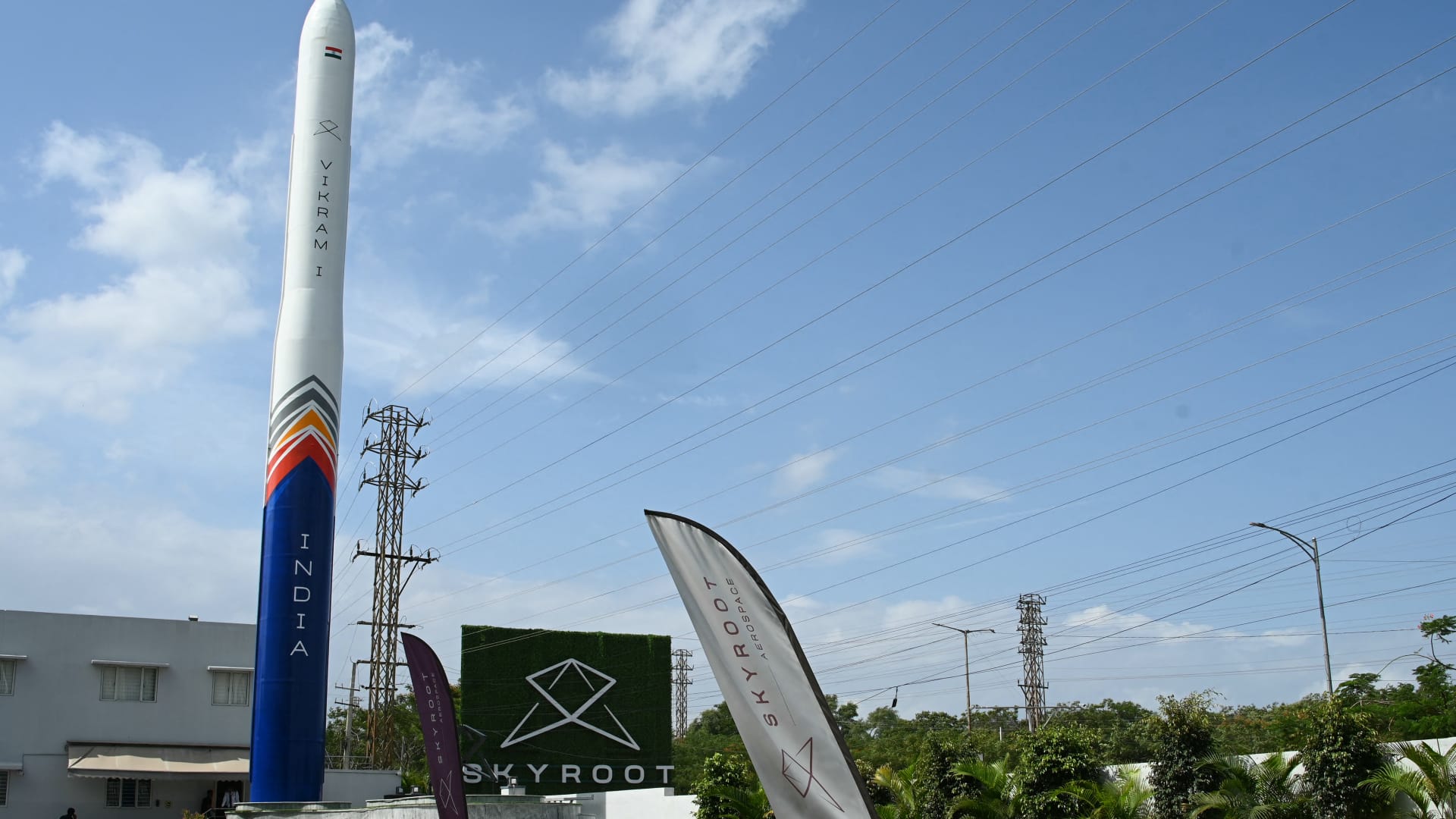
Skyroot Aerospace plans to begin commercial launch services in 2027 after a successful private orbital test carrying a 350-kilogram payload, according to co-founder Naga Bharath Daka. The Indian startup is entering a sub-1,000 kg satellite launch market that Analysys Mason valued at $5 billion in 2025, bringing India into a field led by private operators in the U.S. and China.
Daka told CNBC that Skyroot expects to conduct one additional test flight later this year before opening the service to paying customers. The company then aims to fly “one flight every month,” he said.
The test launch took place on Saturday at 11:30 a.m. Indian Standard Time from the Satish Dhawan Space Centre in Sriharikota, according to CNBC. The mission made Skyroot the first Indian private company with orbital launch capability.
Small payload market
Skyroot is targeting satellites below 1,000 kilograms, a segment served by companies including Rocket Lab, Firefly Aerospace and Astra Space in the U.S., as well as Chinese private firms i-Space, Galactic Energy and CAS Space, according to Analysys Mason data cited by CNBC.
Small launch vehicles address a different requirement from larger rockets. Ujjwal Chaudhry, a partner at Analysys Mason, described a small rocket as an “orbit-on-demand taxi.” He said these vehicles can place a single customer’s payload closer to its required orbital position, while larger launchers often release multiple payloads in less specific locations, leaving satellite operators to use onboard fuel and time to complete positioning.
Dedicated small launches can also reduce dependence on rideshare missions, where smaller satellites wait for available capacity on larger launches. Analysys Mason said limited supply in the segment has contributed to launch calendars being booked one to two years ahead.
Rocket Lab said in May that its backlog had more than doubled from a year earlier to $2.2 billion, with launches booked through 2029. CNBC reported that Rocket Lab’s market capitalization was above $43 billion, compared with Skyroot’s $1.1 billion valuation during a $60 million fundraising in May.
Funding gap and cost focus
Skyroot has raised $150 million since it was founded in 2018, according to CNBC. Daka said the company is “well-funded” for commercial launches next year and would seek more capital when it increases work on a reusable rocket, which he said is not an immediate plan.
The company’s backers include GIC and BlackRock. Natasha Malpani Oswal, founder and general partner at Boundless Ventures, told CNBC that backing from sovereign wealth funds and institutional investors shows later-stage capital is starting to reach Indian space companies at scale, though she said that trend is recent and “not yet a pattern.”
Oswal said India’s pool of patient capital for space technology remains shallow relative to the opportunity. CNBC cited experts who noted that U.S. space startups benefit from deeper private funding markets, while Chinese companies receive government support.
Daka and Skyroot co-founder Pawan Kumar Chandana previously worked at the Indian Space Research Organization. Daka told CNBC that Skyroot has focused on conserving cash and getting early engineering decisions right, contrasting that approach with SpaceX’s faster and more capital-intensive development style. He said Skyroot aims to be the most cost-competitive launch vehicle in the small-payload segment even before scale benefits are realized.
This story draws on original reporting from CNBC.