Volkswagen plans sharper model cuts and lower production capacity
Volkswagen said it will cut its model range by up to half and lower annual capacity to 9 million vehicles, without announcing further job reductions.
By Amanda Ross · Deals Correspondent
· 3 min read
Volkswagen will reduce its model range by as much as 50% over the coming years and scale annual production capacity back to 9 million vehicles, the company said Thursday. The plan marks a further retrenchment by Europe’s largest carmaker as it faces weaker profitability, tariff pressure and stronger competition from Chinese manufacturers.
The company did not announce additional job reductions after talks with its supervisory board, despite recent reports that management has considered a far larger restructuring in Germany. CNBC has reported that proposals under discussion could include closing four German factories and cutting as many as 100,000 jobs.
In a statement, Volkswagen said the slimmer product line would allow it to focus capital and management attention on the market segments it considers most attractive. The capacity target compares with a pre-pandemic goal of 12 million vehicles a year, indicating a lower expected production base for the group.
Chief Executive Oliver Blume said in the company’s release that Volkswagen was entering the next stage of its transformation “by our own means.” He said the plan was intended to make the group faster, more resilient and more competitive.
Restructuring debate in Germany
The announcement followed a supervisory board meeting that drew attention from investors, workers and policymakers. Volkswagen’s governance structure gives labor representatives significant influence, and any plan involving German plant closures or large-scale redundancies would face negotiations with unions and employee bodies.
Manager Magazin reported in late June that Volkswagen was weighing closures at Hanover, Zwickau, Emden and Audi’s Neckarsulm site. CNBC reported that the potential reductions would be twice the 50,000 job cuts previously announced by the company.
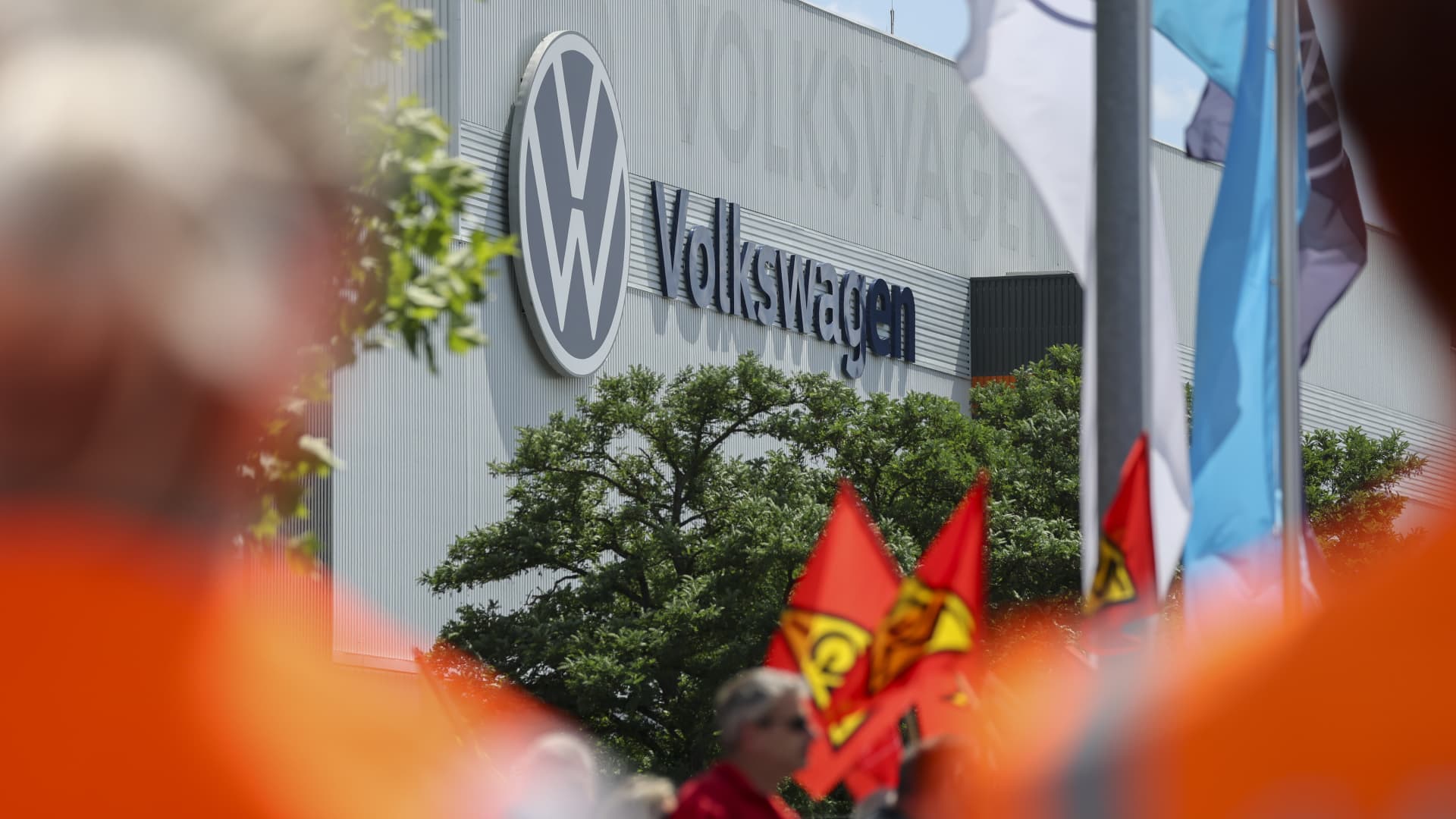
Volkswagen’s General Works Council and IG Metall, Germany’s main industrial union, have opposed the reported measures. IG Metall organized a protest Thursday outside the Volkswagen plant in Zwickau, where workers gathered as concern over factory closures intensified.
The company has already set out plans for broad headcount reductions and a product push, according to CNBC. Those efforts have come as Volkswagen tries to address U.S. import tariffs, pressure across the wider auto sector and intensifying competition from Chinese brands, particularly in electric vehicles and lower-cost models.
Analysts see unanswered questions
Jefferies analysts said Thursday that Volkswagen’s plan offered “limited new information” and gave “no indication of progress” on whether an agreement had been reached over plant closures, a five-year investment plan or further workforce cuts of up to 100,000.
Volkswagen shares were up 0.6% on Friday morning, according to CNBC. The stock has fallen more than 30% this year and has recently traded near levels last seen in the summer of 2010.
Henning Gebhardt, partner and fund manager at HollyHedge Consult, told CNBC’s “Europe Early Edition” that the share price reflected the scale of the company’s problems. He said Volkswagen was facing a “perfect storm,” citing Chinese competition, tariffs, rivals with stronger offerings and pressure on the broader auto industry.
The reduction in model count and capacity outlines how Volkswagen intends to concentrate resources while demand patterns and cost structures change. The unresolved issue for workers and investors is whether the company can secure agreement on the more contentious parts of any restructuring, including plants, investment commitments and staffing levels.
This story draws on original reporting from CNBC.