Permutable global industrial production sentiment splits across major economies
Permutable’s latest reading shows stronger reporting sentiment in Canada, India and South Korea, while the UK, Germany and China declined.
By Sarah Jenkins · Chief Macro Economics Correspondent
· 2 min read
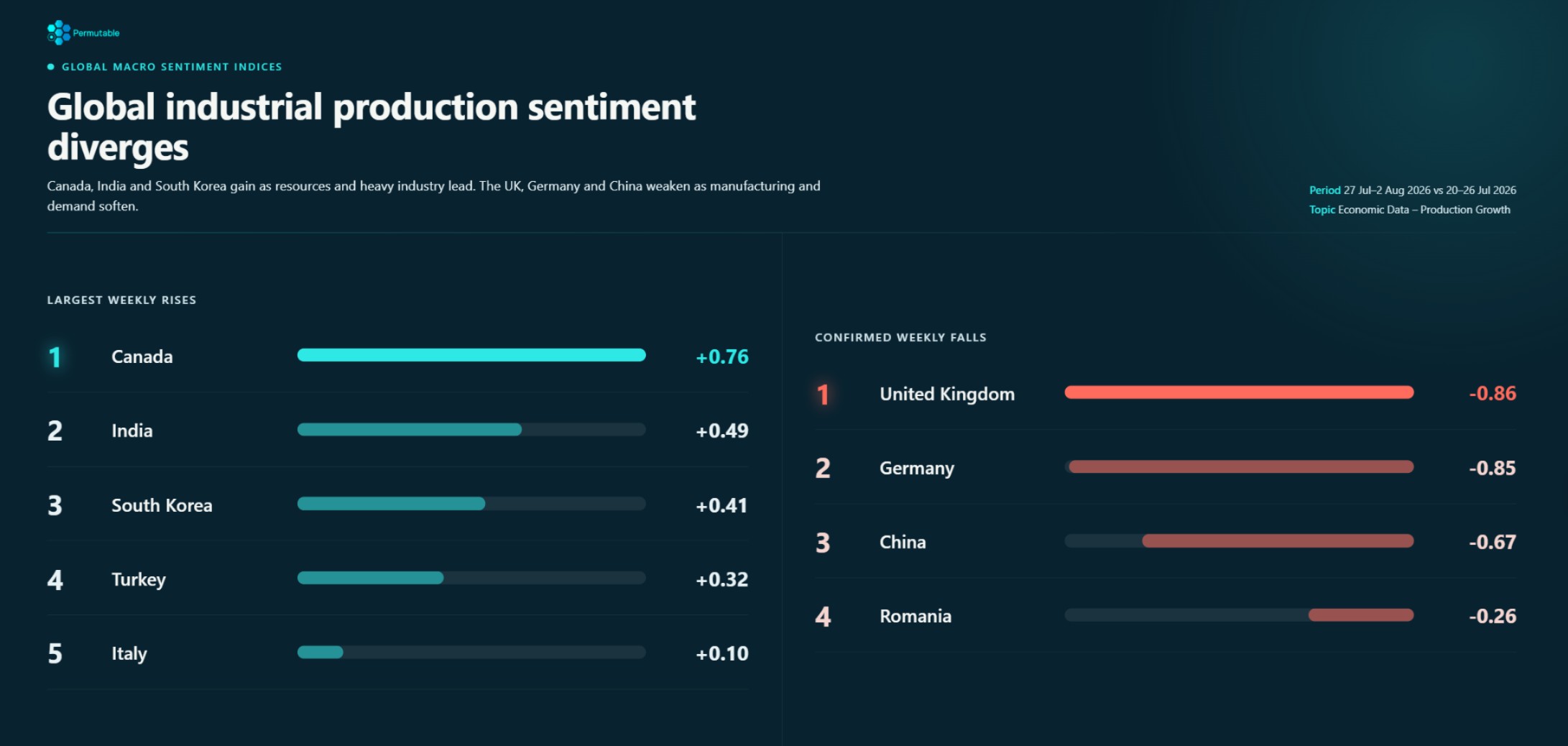
Permutable’s global industrial production sentiment measure diverged sharply in the week to 2 August, with Canada, India and South Korea recording the strongest gains and the UK, Germany and China the largest declines. The company’s figures point to strength concentrated in resources, power supply and investment-linked activity, while vehicle production, weak demand and competitiveness concerns weighed on several major manufacturing economies.
The comparison covers 27 July to 2 August against the preceding seven days. Canada’s score rose by 0.76, followed by India at 0.49 and South Korea at 0.41. Turkey gained 0.32 and Italy 0.10.
- Canada: +0.76
- India: +0.49
- South Korea: +0.41
- Turkey: +0.32
- Italy: +0.10
At the other end of the ranking, the UK’s score fell 0.86, Germany’s declined 0.85 and China’s dropped 0.67. Romania recorded a 0.26 fall.
- United Kingdom: -0.86
- Germany: -0.85
- China: -0.67
- Romania: -0.26
What does global industrial production sentiment show?
The global industrial production sentiment index tracks the direction of reporting in matched industrial-production headlines. It compares the average directional sentiment of coverage between two periods, rather than measuring tonnes produced, factory output or a country’s industrial-production growth rate.
Countries had to have at least 15 matched headlines in both weekly periods to enter the comparison. The reading can indicate where reporting has become more or less constructive about production conditions, capacity or investment, but it is not a substitute for official industrial-output data.
Permutable attributed Canada’s improvement mainly to oil, gas, mining and new productive capacity. India’s rise reflected manufacturing, electricity supply and capital-goods activity, while South Korea’s gains extended beyond semiconductors to facility investment, consumption and business expectations.
That mix suggests an uneven industrial cycle: commodity-linked sectors and capital spending can support activity even when consumer-facing manufacturing remains under pressure. It does not establish that output has risen across every sector in the higher-ranked countries.
In the UK, weaker vehicle production and softer commercial-vehicle demand were cited as the principal pressures. Permutable linked Germany’s deterioration to energy costs, competitiveness, automotive restructuring and concerns about future investment. It attributed China’s decline to softer domestic and external demand despite the country’s productive capacity.
Jack Watson, a market analyst at Permutable, said the latest week showed a wider separation between economies tied to resources, metals and capital goods and markets more exposed to final demand. The company characterised the results as selective strength rather than evidence of a broad global manufacturing recovery.