US trade gap narrowed to $29.4 billion in October
Exports rose and imports fell in October, cutting the U.S. goods and services deficit by $18.8 billion from September’s revised level.
By Sarah Jenkins · Chief Macro Economics Correspondent
· 2 min read
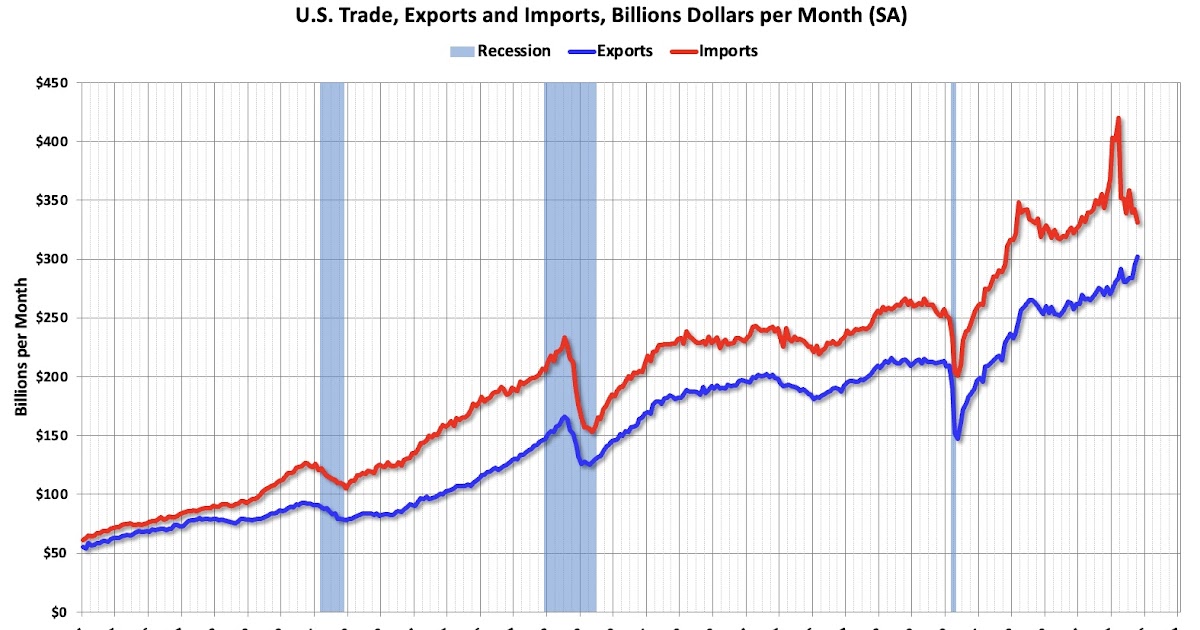
The U.S. goods and services trade deficit fell to $29.4 billion in October, a decline of $18.8 billion from a revised $48.1 billion in September, the Census Bureau and Bureau of Economic Analysis said in a report released Thursday. The narrower gap reflected both stronger exports and lower imports, shifting the monthly balance of trade toward a smaller drag from foreign purchases relative to overseas sales.
Exports reached $302.0 billion in October, up $7.8 billion from September, according to the two agencies. Imports totaled $331.4 billion, down $11.0 billion from the prior month.
The trade deficit measures the difference between what the United States buys from abroad and what it sells to foreign customers. When imports exceed exports, the result is a deficit. In October, the improvement came from both sides of that equation: U.S. shipments to other countries increased, while purchases of foreign goods and services declined.
Exports strengthened as imports retreated
Calculated Risk, summarizing the government figures, noted that exports were 12% higher than a year earlier, while imports were 4% lower year over year. That combination points to a year-on-year improvement in the external accounts, though the monthly data can move sharply when import timing shifts.
The blog also noted that imports had risen sharply earlier in the year as companies moved purchases forward ahead of tariffs. Such timing effects can lift imports in one period and reduce them later, as firms work through inventories or pull demand into an earlier month.
October’s decrease in imports therefore followed a period in which trade flows had been affected by tariff-related ordering decisions, according to Calculated Risk. The official figures did not break out in the excerpted release how much of October’s decline reflected tariff timing, inventory adjustment or changes in underlying demand.
Petroleum and China balances
Calculated Risk also highlighted the distinction between the total trade deficit, the petroleum balance and the deficit excluding petroleum products. It said net exports of petroleum products were positive and had been increasing, meaning petroleum trade was adding to the export side of the ledger on a net basis.
The U.S. trade deficit with China also narrowed. Calculated Risk said the deficit with China was $14.9 billion, compared with $28.1 billion a year earlier.
The October report adds another data point for investors and policymakers assessing trade flows after earlier tariff-related import swings. The headline change was large for a single month, with the $18.8 billion narrowing driven by a $7.8 billion rise in exports and an $11.0 billion fall in imports, according to the Census Bureau and BEA.
This story draws on original reporting from Calculated Risk.