AMD adds Microsoft as Helios customer in challenge to Nvidia AI racks
Microsoft will deploy AMD’s Helios AI rack system in Azure data centers, joining Meta, OpenAI and Oracle as AMD seeks a larger share of AI infrastructure spending.
By Amanda Ross · Deals Correspondent
· 3 min read
Advanced Micro Devices said Microsoft will deploy its new Helios rack-scale artificial intelligence system in Azure data centers, adding a marquee cloud buyer as AMD prepares to ship the product later this year. The order places AMD more directly against Nvidia’s Grace Blackwell and Vera Rubin systems in a market where Futurum Group estimates Nvidia controls more than 95% of data center GPU sales, compared with about 4.5% for AMD.
AMD did not disclose financial terms or the amount of computing capacity Microsoft will receive. Microsoft joins Meta, OpenAI, Oracle and Tata Consultancy Services among early Helios customers, according to AMD and company announcements cited by CNBC.
Microsoft Chief Executive Satya Nadella said in a release that the company is expanding its Azure infrastructure portfolio with AMD Helios to give customers “the performance, scale and choice” needed for future AI applications. Microsoft said the system will support frontier-model inference, Azure AI services and AI customers using its cloud.
The companies also said Microsoft will introduce two computing instances based on AMD’s latest “Venice” central processing units. One is intended for agentic AI and data pipelines, while the other targets semiconductor design workloads.
How Helios is built
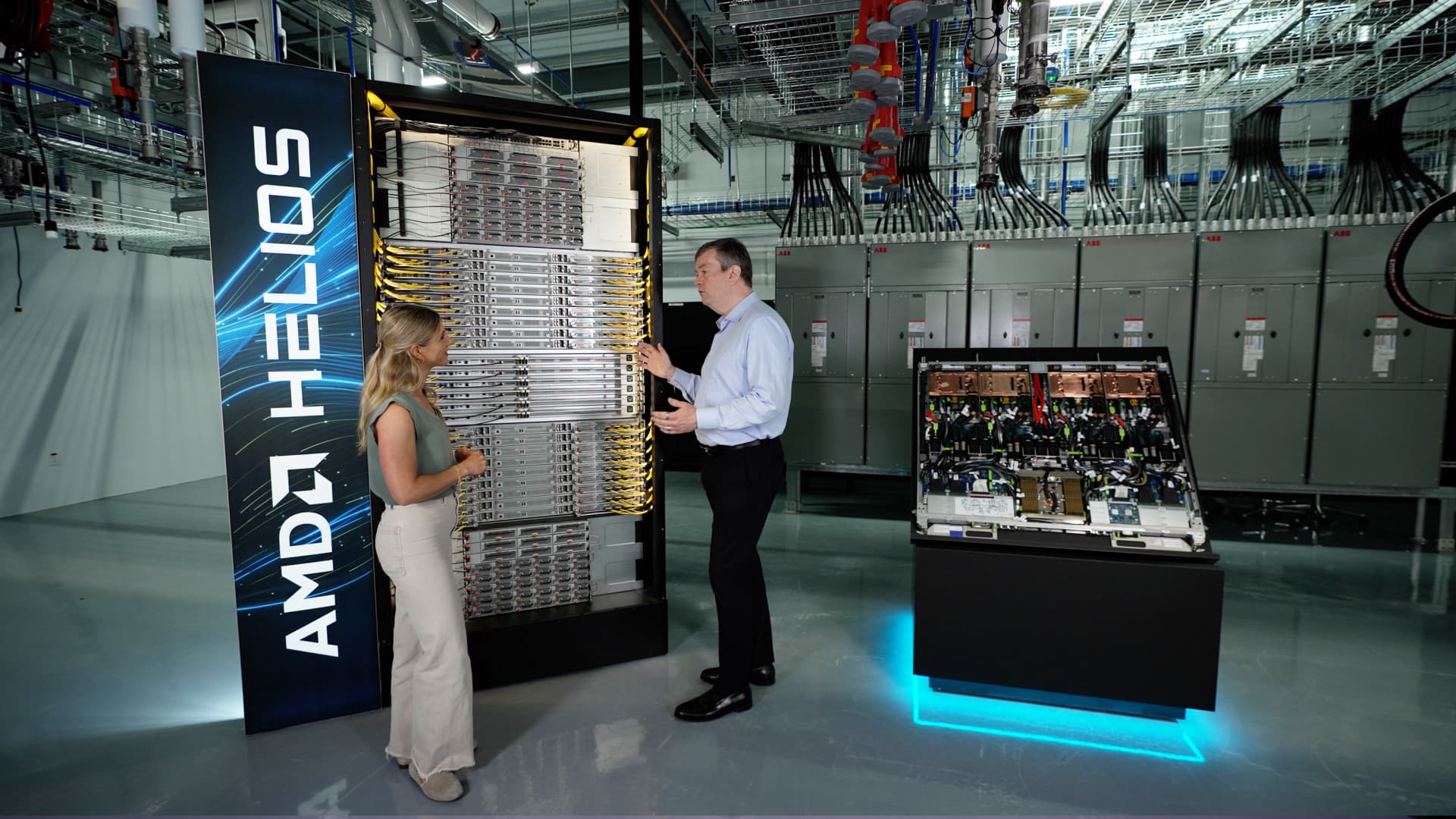
Helios is AMD’s first full rack-scale AI system. Rather than selling only individual chips, AMD is packaging graphics processors, central processors, networking components and software into an integrated rack for large-scale AI workloads.
Forrest Norrod, AMD’s data center chief, told CNBC the company is focused on total cost of ownership and “the lowest cost per token,” a measure used by AI operators to assess the expense of generating model output. AMD Chief Executive Lisa Su told CNBC in May that Helios offers advantages over Nvidia rack systems for inference, memory bandwidth and memory capacity.
Each Helios rack includes 18 compute trays, according to CNBC’s report from AMD’s Texas lab. Each tray contains four Instinct GPUs connected to one EPYC CPU, and can include as many as 12 networking chips that use technology AMD acquired through its 2022 purchase of Pensando.
Futurum Group estimates Helios will cost between $5 million and $5.5 million, while Nvidia’s Vera Rubin system will cost between $3.5 million and $4 million. CNBC reported that Helios can weigh as much as 7,000 pounds and is wider and heavier than Nvidia’s Vera Rubin rack.
Customer demand and competitive limits
Meta said in February it expects to use up to 6 gigawatts of AMD GPUs over time, starting with 1 gigawatt on Helios racks later this year. AMD has also said eight of the 10 largest AI companies run workloads on its Instinct GPUs, including OpenAI, Cohere and Elon Musk’s SpaceXAI, CNBC reported.
The push comes as data centers have become AMD’s largest business. In the first quarter of 2026, the segment accounted for the majority of company revenue and grew 57% from a year earlier, according to AMD figures cited by CNBC. AMD told CNBC it expects tens of billions of dollars in data center AI revenue beginning in 2027, with most of that tied to Helios.
AMD’s position in server CPUs, built around EPYC chips first introduced in 2017, gives it an in-house component Nvidia has only more recently emphasized. Norrod said AMD’s progress under Su reflected a long-term product road map that the company delivered across several generations.
Software remains a central hurdle. Neil Shah, an analyst at Counterpoint Research, told CNBC that AMD’s chips are “on par” with Nvidia’s GPUs and CPUs, but said Nvidia’s CUDA software ecosystem remains ahead of AMD’s ROCm platform. Daniel Newman, chief executive of Futurum Group, said AMD could potentially reach 20% to 25% share, while noting that early wins may reflect both technology and tight industrywide supply.
This story draws on original reporting from CNBC.