Banks, inflation data and Johnson & Johnson set up key market week
Second-quarter bank earnings and June inflation reports will give investors fresh readings on U.S. demand, credit conditions and rate pressure.
By Sarah Jenkins · Chief Macro Economics Correspondent
· 4 min read
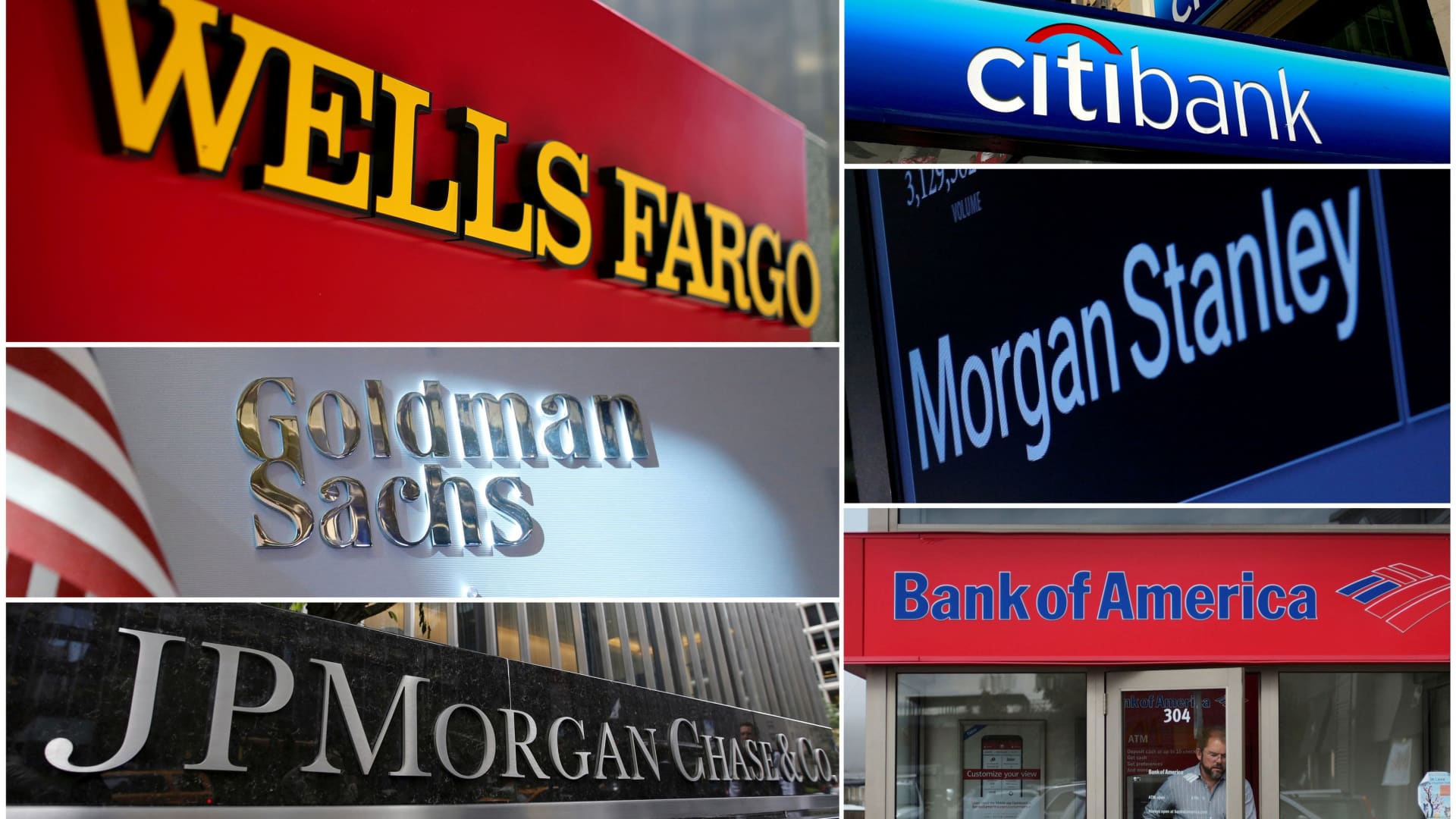
U.S. markets enter a data-heavy week led by second-quarter earnings from major banks and two June inflation reports that could shape expectations for Federal Reserve policy. JPMorgan Chase, Bank of America, Citigroup, Wells Fargo and Goldman Sachs are due to open the bank reporting cycle on Tuesday, the same morning the consumer price index is scheduled for release at 8:30 a.m. ET.
CNBC’s Investing Club said the common link across the week’s largest events is the condition of the U.S. economy. Beyond the banks, investors will hear from companies with exposure to household spending and business activity, including J.B. Hunt, Netflix and United Airlines. Johnson & Johnson reports Wednesday morning.
Bank results will test credit and capital-market momentum
Wells Fargo and Goldman Sachs both report before Tuesday’s opening bell. CNBC’s Investing Club said Wells Fargo’s call is scheduled for 10 a.m. ET, while Goldman Sachs begins at 9:30 a.m. ET.
Large banks give investors more than company-level results because their balance sheets, payments flows, loan books and capital-markets operations offer timely signals on consumers, corporations and global financing conditions. Executives’ commentary on deposit trends, loan demand, credit quality and deal activity will be watched alongside reported revenue and earnings.
For Wells Fargo, Wall Street expectations cited by CNBC’s Investing Club stand at $21.8 billion in revenue and earnings per share of $1.72. The club said attention will fall on whether the bank can return to beating analyst estimates after two weaker quarters, as well as whether management can support a path toward return on tangible common equity in the 17% to 18% range.
Return on tangible common equity measures how efficiently a bank turns its tangible equity capital into profit. Investors also monitor the efficiency ratio, calculated as operating expenses divided by net revenue, because it indicates how much cost is required to generate income.
For Goldman Sachs, Wall Street expectations cited by CNBC’s Investing Club are $16.1 billion in revenue and earnings per share of $14.39. The club said the first half’s active deal market, including SpaceX’s second-quarter IPO led by Goldman, creates a strong backdrop for investment banking revenue. Investors will also look for evidence of earnings durability outside periods of elevated mergers, acquisitions and IPO activity.
Johnson & Johnson reports after health-care rally
Johnson & Johnson enters its earnings week near record levels after a rally across health-care shares, according to CNBC’s Investing Club. Wall Street expects revenue of $25.05 billion and earnings per share of $2.85, the club said.
The company’s pharmaceutical products Darzalex, a blood-cancer therapy, and Tremfya, an injectable treatment for autoimmune conditions affecting the skin and digestive tract, are expected to receive investor attention. Updates are also expected on Icotyde, a daily psoriasis pill approved by U.S. regulators in March.
Goldman Sachs analysts told clients last week they do not expect Johnson & Johnson to provide an Icotyde revenue figure, consistent with the company’s practice for early product launches, according to CNBC’s Investing Club. Prescription trends and patient mix are expected to be more relevant near-term indicators.
In medical devices, the club said growth drivers include cardiovascular products from Shockwave, which Johnson & Johnson acquired in 2024, and Impella heart pumps. Last quarter, Johnson & Johnson’s pharmaceutical unit reported $15.4 billion in sales and 7.4% organic growth, while medical devices reported $8.6 billion in sales and 4.6% organic growth.
Inflation and oil remain central to the rates debate
The June CPI report is due Tuesday, followed by the producer price index on Wednesday. FactSet economists cited by CNBC’s Investing Club expected CPI to rise 3.8% from a year earlier and decline 0.2% month over month. They expected PPI to rise 6.2% annually and fall 0.2% on the month.
PPI is viewed as a leading indicator for consumer inflation because it measures prices received by producers. If companies face higher input costs, they may later try to pass those costs through to finished goods.
Energy prices are a key variable. CNBC’s Investing Club said West Texas Intermediate crude fell from the low $90s a barrel in early June to just below $70 by month-end after an interim peace agreement between the U.S. and Iran led to a partial reopening of the Strait of Hormuz. The club said tensions rose again last week, tanker traffic through Hormuz slowed, and missiles and drones continued over the weekend.
Other scheduled data include June retail sales, Friday housing starts, and the Federal Reserve’s monthly readings on industrial production and capacity utilization.
This story draws on original reporting from CNBC.