India agrees missile supply pact with Indonesia as regional demand rises
New Delhi’s BrahMos and Astra agreement with Jakarta follows earlier BrahMos deals with the Philippines and Vietnam amid Indo-Pacific security concerns.
By Sarah Jenkins · Chief Macro Economics Correspondent
· 4 min read
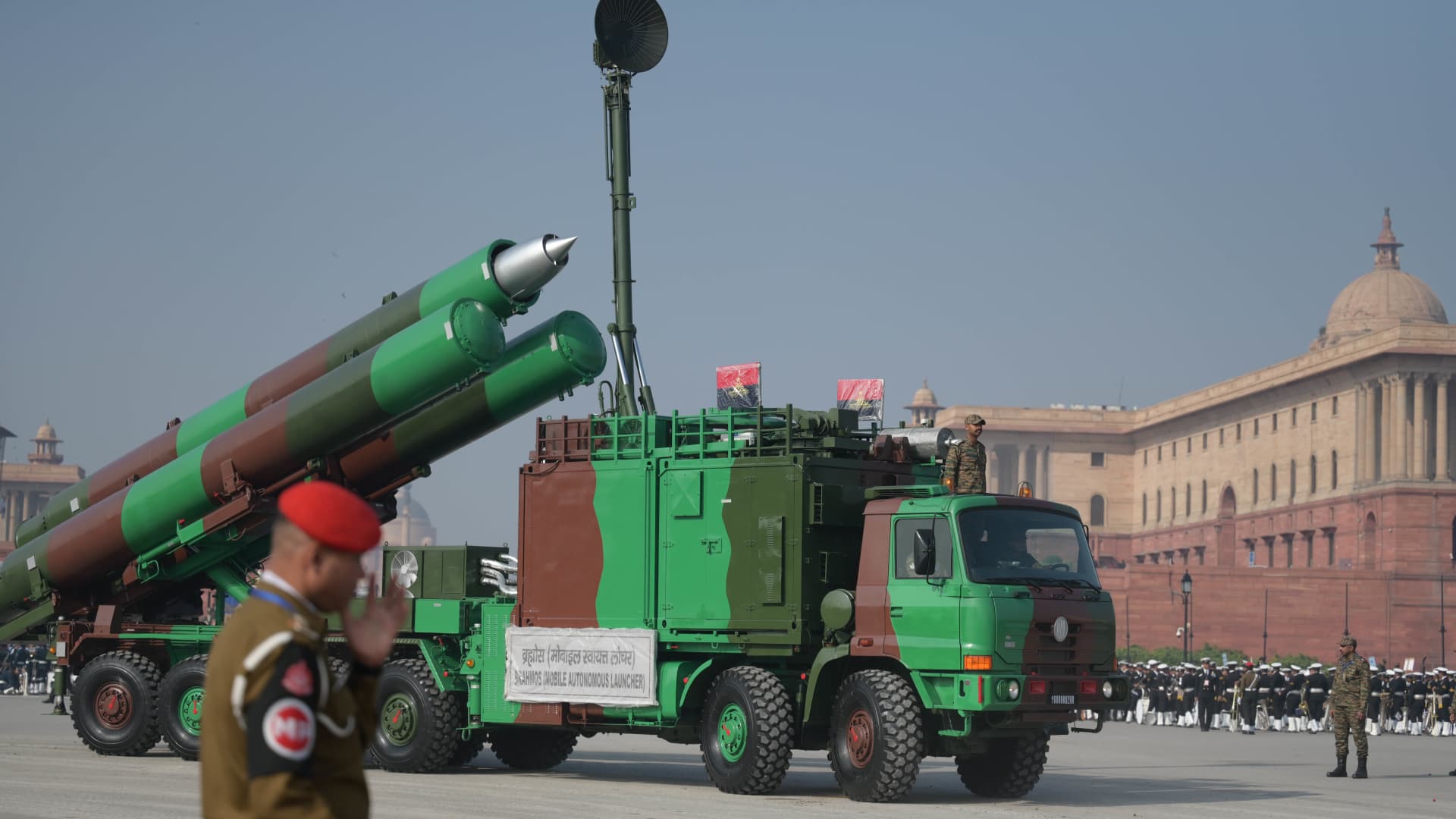
India has agreed a pact to supply BrahMos and Astra missiles to Indonesia, marking its third Indo-Pacific missile agreement as regional governments reassess defence needs around China’s expanding military reach. The commercial terms have not yet been settled, an Indian foreign ministry spokesperson said on Tuesday.
The agreement adds Indonesia to a short list of regional buyers of Indian missile systems. The Philippines became the first overseas customer for BrahMos in 2022, according to India’s Press Information Bureau, and India’s defence secretary said in May that New Delhi had signed a BrahMos sale with Vietnam, Reuters reported.
BrahMos is a supersonic cruise missile with an anti-ship role. Siemon Wezeman, senior researcher in the Arms Transfers Programme at the Stockholm International Peace Research Institute, told CNBC that regional buyers have focused on the anti-ship version, which has a range of 300 kilometres and travels at a speed that makes interception difficult.
Wezeman described BrahMos to CNBC as among the largest and fastest missiles currently available for export. BrahMos Aerospace is a joint venture between India’s Defence Research and Development Organisation and Russia’s NPO Mashinostroyenia.
Douglas Barrie, senior fellow for military aerospace at the International Institute for Strategic Studies, told CNBC by email that China’s YJ-12 is the only comparable missile. The Astra system referenced by India is an air-to-air missile, according to the Indian foreign ministry spokesperson’s comments on the new areas of cooperation with Indonesia.
South China Sea concerns shape demand
Analysts cited by CNBC linked the Philippines and Vietnam deals to concerns over China’s actions in the South China Sea. Collin Koh, a senior fellow at the Institute of Defence and Strategic Studies, told CNBC that both purchases were driven by perceptions of a growing Chinese threat in those waters.
Indonesia’s position is more nuanced. Koh said Jakarta does not regard China as its main security threat, but has differences with Beijing over what Indonesia calls the North Natuna Sea. The area sits near contested maritime claims and has become part of the wider regional security debate.
China’s navy test-fired a ballistic missile into the Pacific on Monday, CNBC reported, a development expected to encourage more defence cooperation among countries in the region. Farwa Aamer, director of South Asia initiatives at the Asia Society Policy Institute, told CNBC that Indo-Pacific defence partnerships are being strengthened as part of efforts to address the China threat.
Aamer said regional governments also want defence relationships that are less dependent on the United States, which helps make India a viable partner and the BrahMos system attractive. Experts told CNBC that India is viewed in the region as a transactional supplier rather than a power bloc patron, and is not seen as a direct security threat.
Exports remain small beside India’s ambitions
The missile deals give New Delhi a visible role in regional arms supply, but analysts said they do not yet make India a major defence exporter. Wezeman told CNBC that BrahMos sales show India has entered the ranks of arms producers and exporters, while adding that its export record remains limited for larger contracts.
Orders for Indian Tejas fighter aircraft or frigates would be worth considerably more than several BrahMos contracts, Wezeman said. India’s defence exports have risen over the past decade but reached 384 billion rupees, or about $4 billion, in the financial year ended March 2026.
That total is slightly above 1% of the $331 billion in arms sales recorded by the United States, the world’s largest arms supplier, according to U.S. State Department figures cited by CNBC. SIPRI’s 2021-2025 major arms transfer data does not place India among the top 25 arms exporters, while China ranks fifth and South Korea ninth.
India remains a much larger buyer than seller of military equipment. SIPRI’s 2026 yearbook ranks New Delhi as the world’s fifth-largest military spender and the second-largest arms importer, with more than 8% of global import share.
This story draws on original reporting from CNBC.


