NATO summit turns on Trump as Iran, Ukraine and spending dominate
CNBC reported that a 48-hour NATO gathering in Ankara shifted from confrontation to public unity, while questions over Iran, Ukraine and U.S. commitments remained unresolved.
By Sarah Jenkins · Chief Macro Economics Correspondent
· 3 min read
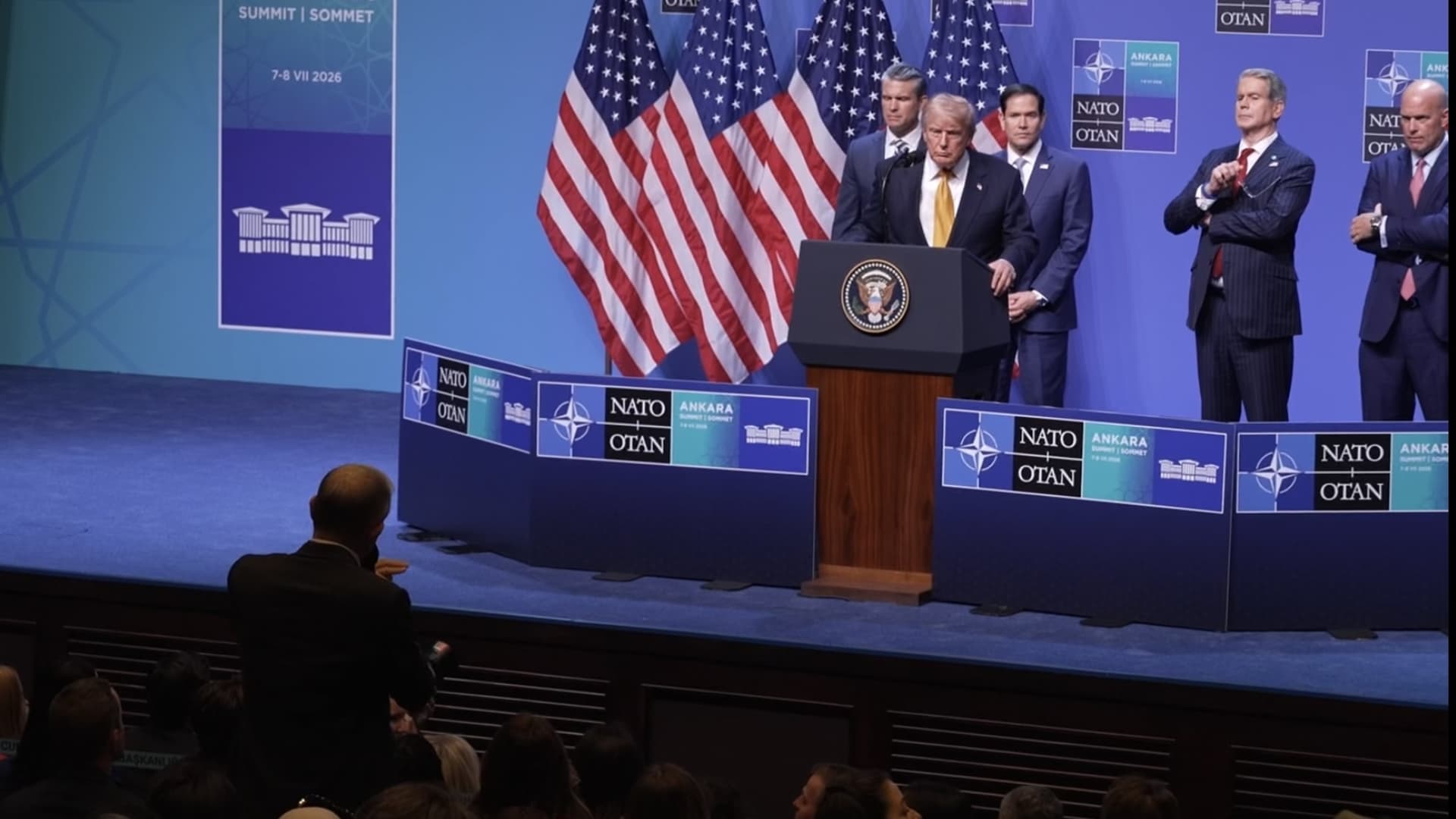
A 48-hour NATO summit in Ankara was dominated by U.S. President Donald Trump, with Iran, Ukraine, defense spending and European security all drawn into a volatile diplomatic sequence, CNBC reported. Markets fell and oil prices rose after Trump signaled he was finished dealing with Iran on a memorandum of understanding and ceasefire, before allied leaders later described a much warmer closed-door exchange with the U.S. president.
The gathering put European NATO members and Canada under renewed pressure from Washington over military spending and support for U.S. policy on Iran. CNBC reported that Trump and Defense Secretary Pete Hegseth had criticized allies ahead of and during the summit for not contributing enough to their own defense and for insufficient support over Iran.
Spain drew particular attention because of its refusal to meet NATO military spending targets, according to CNBC. Denmark also faced pressure after Trump again raised Greenland, whose transfer to the United States Denmark has refused. The summit also included Ukrainian President Volodymyr Zelenskyy, who arrived seeking further backing from NATO as Kyiv continued to press for military support.
Shift behind closed doors
According to CNBC, the tone of the summit changed sharply after a closed-door leaders’ meeting. Officials who spoke to CNBC characterized Trump as pleased with the discussion and said he had listened to other leaders. The public signal came later at Trump’s closing press conference, where he stood with Secretary of State Marco Rubio, Treasury Secretary Scott Bessent, Hegseth and Deputy Chief of Staff Stephen Miller.
Trump said there had been “tremendous love in the room” during the leaders’ meeting, according to CNBC. He also said, “The unity was amazing,” and added, “The love was pretty wild.” The remarks contrasted with his earlier criticism of several allies and eased immediate concern that the summit would end in a public rupture.
NATO summits often revolve around U.S. policy because Washington remains the alliance’s largest military power. In Ankara, CNBC reported, the agenda appeared to depend heavily on Trump’s positions across several issues at once: Iran, Russia’s war in Ukraine, Greenland, alliance spending and the future of U.S. support for Kyiv.
Ukraine and defense industry questions
CNBC reported that Zelenskyy appeared to receive a warmer response from Trump than in earlier encounters. Ukraine may also have moved closer to an arrangement involving production of Patriot missile systems, which Kyiv has long prioritized, though CNBC presented that outcome as a possibility rather than a confirmed agreement.
Patriot systems are advanced air-defense batteries designed to detect, track and intercept incoming missiles and aircraft. For Ukraine, expanded access would be relevant to protecting cities, infrastructure and military positions from Russian strikes. Any production arrangement would depend on industrial capacity, financing and government approvals.
Turkish President Recep Tayyip Erdoğan also emerged from the summit in a stronger position after hosting the event smoothly, CNBC reported. The outlet said Erdoğan appeared to move nearer to securing U.S. approval for F-35 fighter jets. NATO Secretary General Mark Rutte, meanwhile, continued to praise Trump, a posture CNBC said helped keep the United States engaged with the alliance for the time being.
Iran remains unresolved
The sharpest unresolved issue remained Iran. CNBC reported that Trump had said he was done with the ceasefire and related diplomatic track, prompting the market reaction. Asked what would come next if the ceasefire was no longer viable, Trump returned to his position that Iran would not obtain a nuclear weapon while he was president, according to CNBC.
The summit ended with a stronger display of NATO unity than many participants had expected, according to CNBC, but without clear answers on Iran, the durability of the improved mood with Washington, or the longer-term implications for Ukraine. Russia’s President Vladimir Putin would likely have viewed the show of allied unity, progress on defense spending and Trump’s warmer treatment of Ukraine unfavorably, CNBC reported.
This story draws on original reporting from CNBC.