Trump declares Iran ceasefire ended as oil jumps after US strikes
The U.S. president said talks with Tehran were a “waste of time” after new strikes tied to attacks on commercial vessels in the Strait of Hormuz.
By Sarah Jenkins · Chief Macro Economics Correspondent
· 3 min read
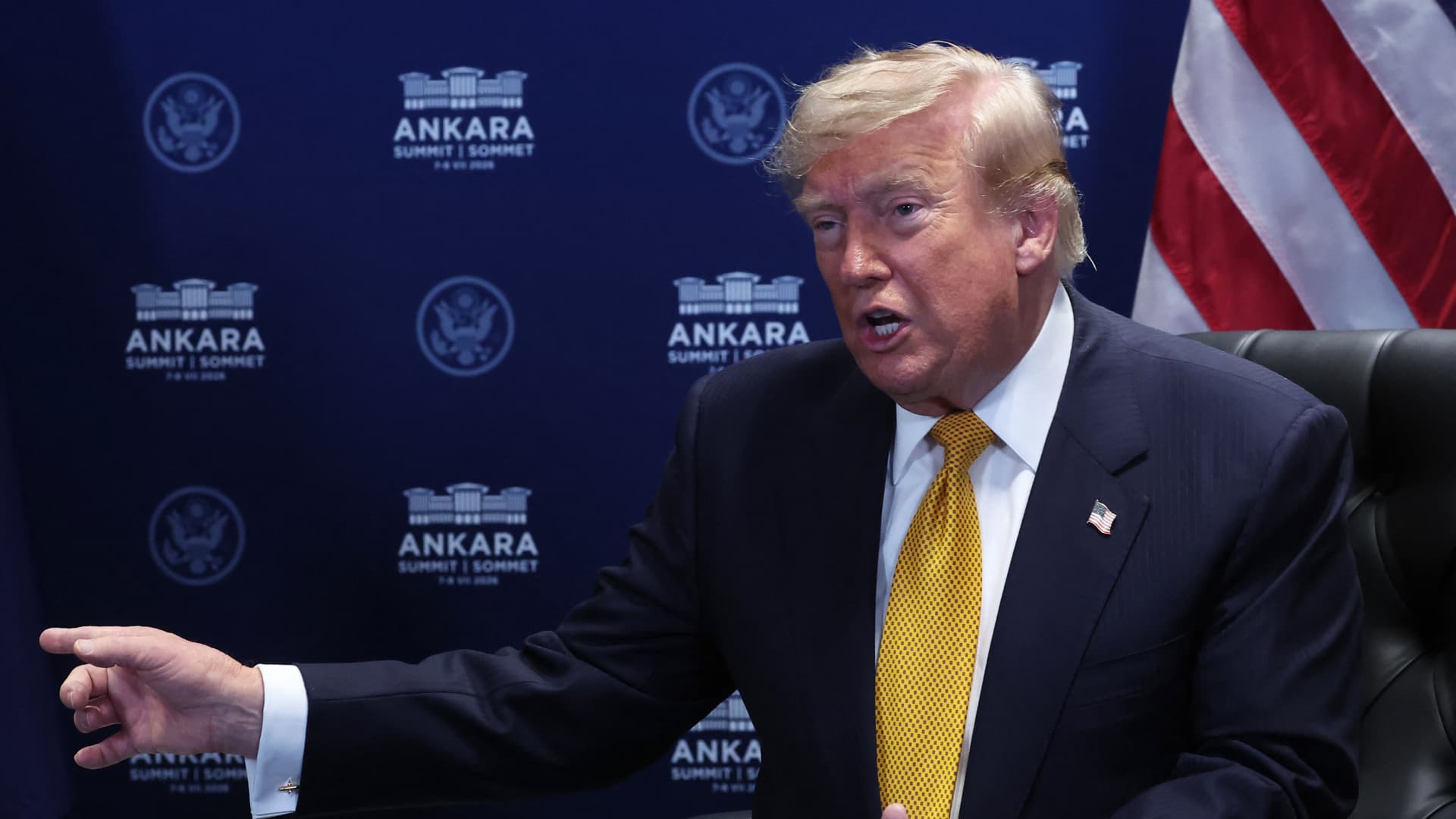
U.S. President Donald Trump said Wednesday that Washington’s ceasefire with Iran had ended, after the U.S. military carried out fresh strikes and both governments accused the other of breaching last month’s accord. Oil prices rose sharply after his remarks, with Brent crude futures for September delivery up 5.7% at about $78.41 a barrel and West Texas Intermediate futures gaining 5.9% to settle at $74.60.
Speaking at a joint press conference with NATO Secretary General Mark Rutte during the alliance’s summit in Ankara, Turkey, Trump answered a reporter’s question by saying, “I think it’s over.” He added, “I don’t want to deal with them anymore,” and said that, “as far as I’m concerned, it’s over.”
Trump said the U.S. delegation had sought a peace agreement with Iran, but he described further talks with Tehran as “a waste of time.” His comments followed an overnight escalation around the Strait of Hormuz, a central channel for oil and other commodities moving out of the Gulf.
U.S. cites attacks on shipping
U.S. Central Command said in a post on X that American forces struck more than 80 targets in Iran. CENTCOM said the targets included air defense systems, command-and-control networks and anti-ship missile capabilities.
The command also said more than 60 small boats tied to Iran’s Islamic Revolutionary Guard Corps were hit. CENTCOM said the operation was intended to reduce Iran’s ability to attack international commerce.
In an earlier statement on X, CENTCOM said the strikes were a response to Iranian attacks on three commercial vessels moving through the Strait of Hormuz. The command said those attacks targeted ships crewed by civilians in an international waterway and amounted to a breach of the ceasefire.
A military strike of this type can affect energy markets through two channels. Direct damage to anti-ship systems may reduce immediate threat capacity, while the escalation itself raises perceived risk for vessels, insurers and commodity buyers using the route. The Strait of Hormuz has previously been effectively closed during the U.S.-Iran war, a disruption that pushed oil prices higher and raised concern about broader inflation pressure.
Iran says U.S. violated accord
Iran’s foreign ministry rejected Washington’s account and said Wednesday that the American strikes were a “gross violation of the Memorandum of Understanding” reached last month by the two countries to end the war, according to a Google translation of the ministry’s statement.
The ministry said Iran’s armed forces “will not hesitate” to defend the country’s territorial integrity, sovereignty and national security against what it called American military aggression.
The diplomatic rupture came alongside a U.S. financial measure aimed at Iran’s energy exports. The Treasury Department withdrew a waiver that had permitted Iran to sell oil. Such waivers can narrow the practical reach of sanctions by allowing specific transactions that would otherwise be restricted; removing one reduces the legal space for buyers and intermediaries to handle the covered trade.
The latest confrontation follows similar exchanges last month, when the U.S. and Iran traded attacks after incidents involving commercial vessels in the same waterway. For energy markets, the immediate focus remains on whether shipping through Hormuz faces further disruption and whether retaliatory action expands beyond the targets described by U.S. officials.
This story draws on original reporting from CNBC.


