World Cup trading lifts prediction markets to record monthly volumes
Kalshi, Polymarket and Rothera reported sharp June volume gains as football contracts drew heavy activity during the tournament.
By Amanda Ross · Deals Correspondent
· 3 min read
The 2026 FIFA World Cup coincided with record activity across prediction-market venues in June, with Kalshi exceeding $31 billion in monthly notional volume and Polymarket’s international exchange topping $10.8 billion. The surge shows how sports-linked event contracts have become a major source of turnover for platforms seeking broader participation from retail users and institutions.
Kalshi’s June notional volume rose more than 70% from $17.9 billion in May, according to user-collected data on Dune Analytics cited by CNBC. Since the tournament began on June 11, the platform has handled more than $1 billion in daily volume on a consistent basis, according to the same data.
Polymarket’s international venue also reached a monthly high, with more than $10.8 billion in notional trading in June. That marked a reversal after lower volumes in April and May, CNBC reported. Polymarket’s U.S. platform recorded more than $3.5 billion in June notional volume, compared with $1.77 billion in May.
Notional volume measures the face value of contracts traded, rather than the revenue earned by a platform or the amount of money ultimately won or lost. In prediction markets, users buy and sell contracts tied to the outcome of specified events, such as a team winning a tournament. Prices often move in relation to market-implied probabilities, though they are not guarantees of an outcome.
U.S. match draws attention
The United States is scheduled to face Belgium in the round of 16 on Monday night. Contracts tied to whether the U.S. will win the tournament have generated more than $64 million in trading on Kalshi and $122 million on Polymarket, according to CNBC. The market-implied odds stood at 4.3% on Kalshi and 3% on Polymarket.
Rothera, an event-contract exchange formed as a joint venture between Susquehanna International Group and Robinhood, also saw a rapid build-up after its June launch. Robinhood began routing certain World Cup contracts from its brokerage to Rothera during the month, CNBC reported.
Rothera recorded $2 billion in notional trading volume in June and held 7% of U.S. prediction-market volume, according to Bank of America. The platform’s daily volumes rose sharply after the tournament began, according to Dune Analytics data cited by CNBC.
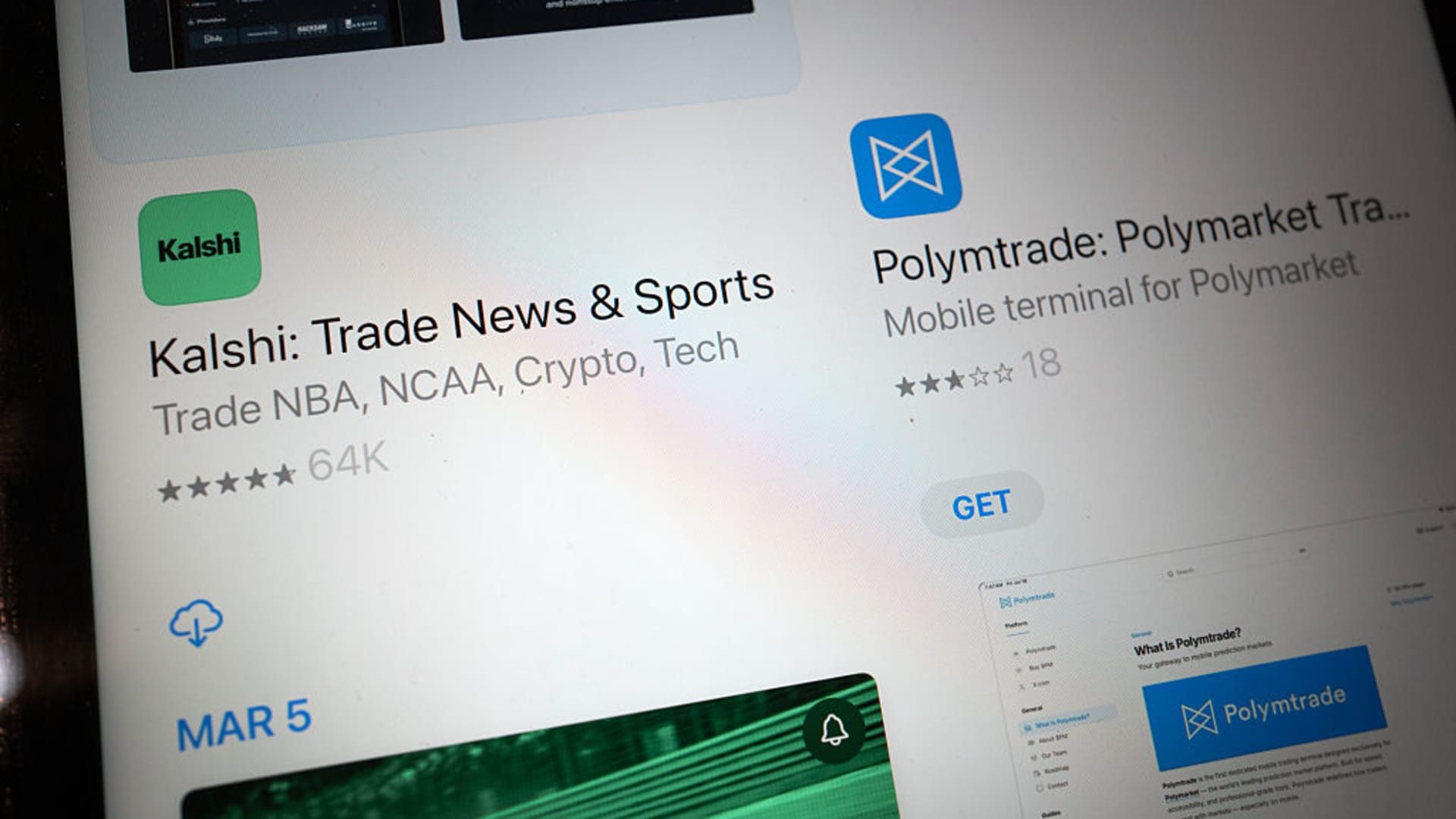
Platforms sought to draw users with tournament-focused products and promotions. Polymarket announced a contest offering up to $2 million for a perfect World Cup knockout-stage bracket, while Kalshi promoted World Cup trading in the title of its mobile app listing on Apple’s App Store, according to CNBC.
Open interest rises
Open interest, a measure of active contracts that have not yet settled, also climbed. Kalshi’s open interest is now above $1 billion, while Polymarket’s is just under $400 million, CNBC reported. Polymarket’s figure remains elevated, though broadly in line with levels on its international platform in recent months.
Asaf Meir, chief executive of market-integrity company Solidus Labs, told CNBC the tournament is a test for prediction-market platforms as regulators and institutions monitor their performance. Solidus Labs has a partnership with Kalshi.
Meir said observers are assessing whether the platforms are safe, mature and liquid enough. He described the World Cup as a pressure test for whether prediction markets can maintain fair conditions during an extended period of high trading volume.
CNBC disclosed that it has a commercial relationship with Kalshi that includes customer acquisition and a minority investment.
This story draws on original reporting from CNBC.