Trump says Eric manages his money as policy disputes remain unresolved
In a CNBC interview, Trump discussed family investments, Fed Governor Lisa Cook, a housing bill, voter ID legislation and the Supreme Court.
By Amanda Ross · Deals Correspondent
· 4 min read
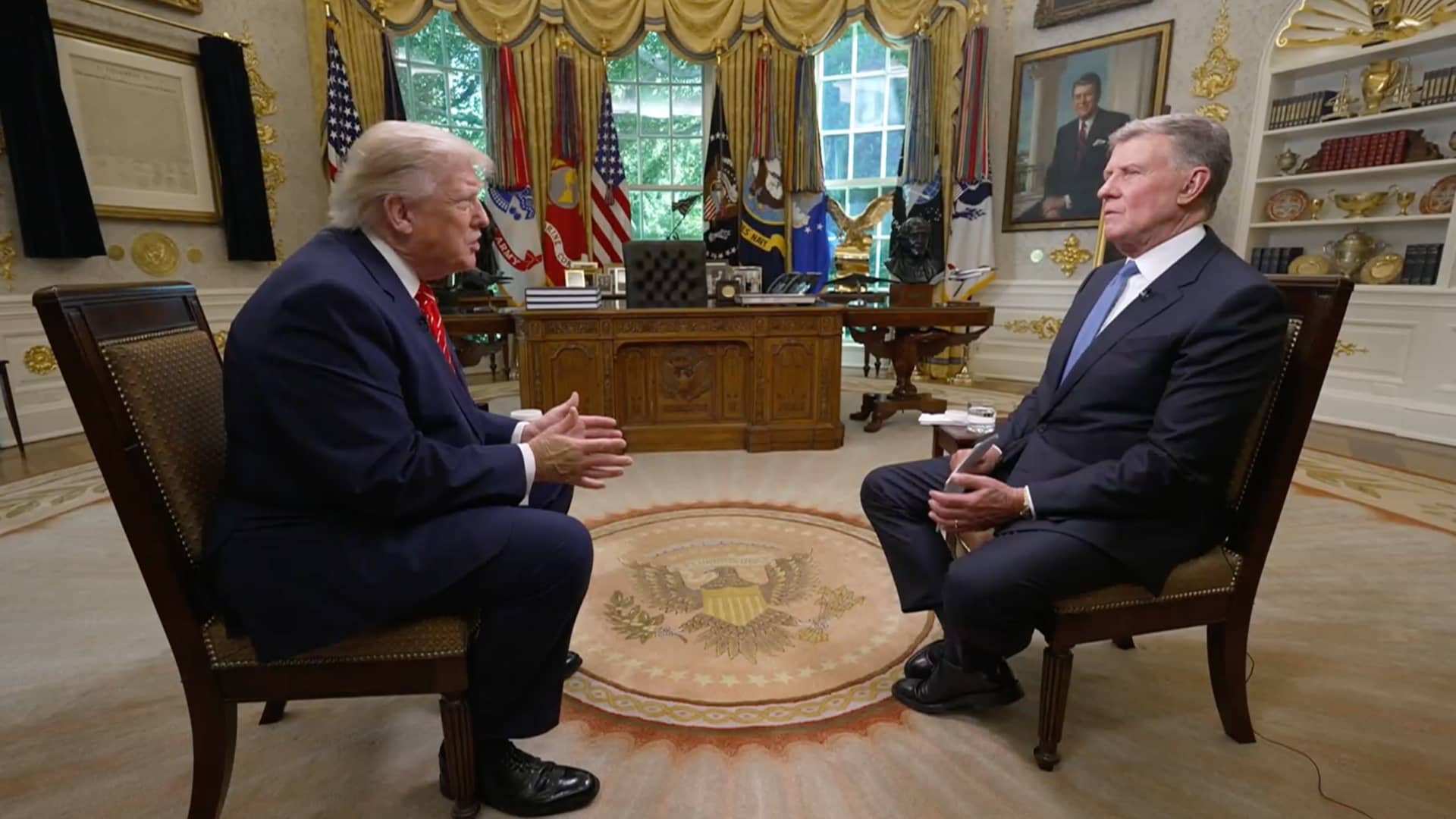
President Donald Trump said his son Eric Trump helps oversee his finances after a disclosure showing more than $2 billion in 2025 income, while defending family business activity that has drawn scrutiny in Washington. In an Oval Office interview with CNBC’s Joe Kernen, Trump also said he still wants to remove Federal Reserve Governor Lisa Cook and declined to commit to signing a bipartisan housing affordability bill.
Trump’s comments put several financial and policy questions back before investors and lawmakers: the boundaries between presidential power and private investments, the independence of the Federal Reserve, and the fate of housing legislation that passed Congress with support from both parties.
Family investments and financial controls
Trump told CNBC that the presidency creates potential conflict questions around almost any investment by his children. He said, “Anything they do, because the presidency is so powerful,” can be viewed through the lens of administration policy, giving the example of a business tied indirectly to energy costs.
CNBC reported that investments by Trump’s children have faced scrutiny because some holdings have overlapped with administration priorities. The report said the Trump administration has approved deals or contracts involving companies in which younger members of the Trump family invested, including drone manufacturers and mining ventures. Some Democrats in Congress have sought reviews of those transactions for possible conflicts of interest or insider trading, according to CNBC.
Asked about his own assets, Trump said the money is handled by major financial firms and by Eric Trump. “I don’t talk to him about things such as this,” Trump said, adding that Eric places assets into “semi-blind trusts or blind trusts where people invest.”
A blind trust is intended to separate an officeholder from direct knowledge or control of investment decisions. Trump’s description, as reported by CNBC, indicated that his children continue to have a role in financial management. The White House has previously said Trump’s finances are managed by his children and has denied wrongdoing related to the president’s business interests.
CNBC said Trump’s financial disclosure included about $515 million from sales of World Liberty Financial tokens and $65 million from sales of equity in the crypto venture’s holding company. Trump told CNBC there was “nothing illegal” and “nothing wrong” with the crypto business.
Fed dispute and Supreme Court comments
Trump said he remains intent on firing Federal Reserve Governor Lisa Cook, after the Supreme Court blocked the move for now while Cook’s legal challenge continues. CNBC reported that the justices ruled 5-4 that Cook could stay in place during the litigation, without resolving the merits of the case.
Trump said he could remove Cook by “winning the case” and argued that the Supreme Court action concerned “process and procedure.” CNBC reported that Trump is seeking to fire Cook over alleged mortgage fraud raised by Bill Pulte, head of the Federal Housing Finance Agency and acting director of national intelligence.
Trump also criticized voting patterns on the Supreme Court, saying liberal justices tend to vote together while conservative justices are less predictable. He referred to the conservative wing as “our people,” according to CNBC. Supreme Court justices hold lifetime appointments and are formally nonpartisan, though presidents generally select nominees with perceived ideological leanings.
Housing bill tied to voter ID fight
Trump did not say whether he would sign a bipartisan housing affordability bill that cleared Congress. He told CNBC the measure contains “a lot of Democrat points” and said he would prefer not to sign legislation until Congress passes the SAVE America Act.
The SAVE America Act would require voter identification as proof of citizenship to register to vote, according to CNBC. Trump also wants measures such as a ban on mail-in voting attached to the effort, though CNBC reported that such proposals have limited support in Congress.
The housing bill can become law without Trump’s signature unless he vetoes it, CNBC reported. Trump has not said he will veto the measure. He also said he wants the Senate to eliminate the filibuster, a rule that generally requires 60 votes to advance most legislation. CNBC reported that Senate Republicans do not appear ready to take that step.
This story draws on original reporting from CNBC.