Paris Hilton and Ocasio-Cortez urge House vote on DEFIANCE Act
Paris Hilton and two House members pressed for a vote on a Senate-passed bill that would expand civil remedies for explicit digital forgeries.
By Marcus V. Thorne · Markets Editor
· 3 min read
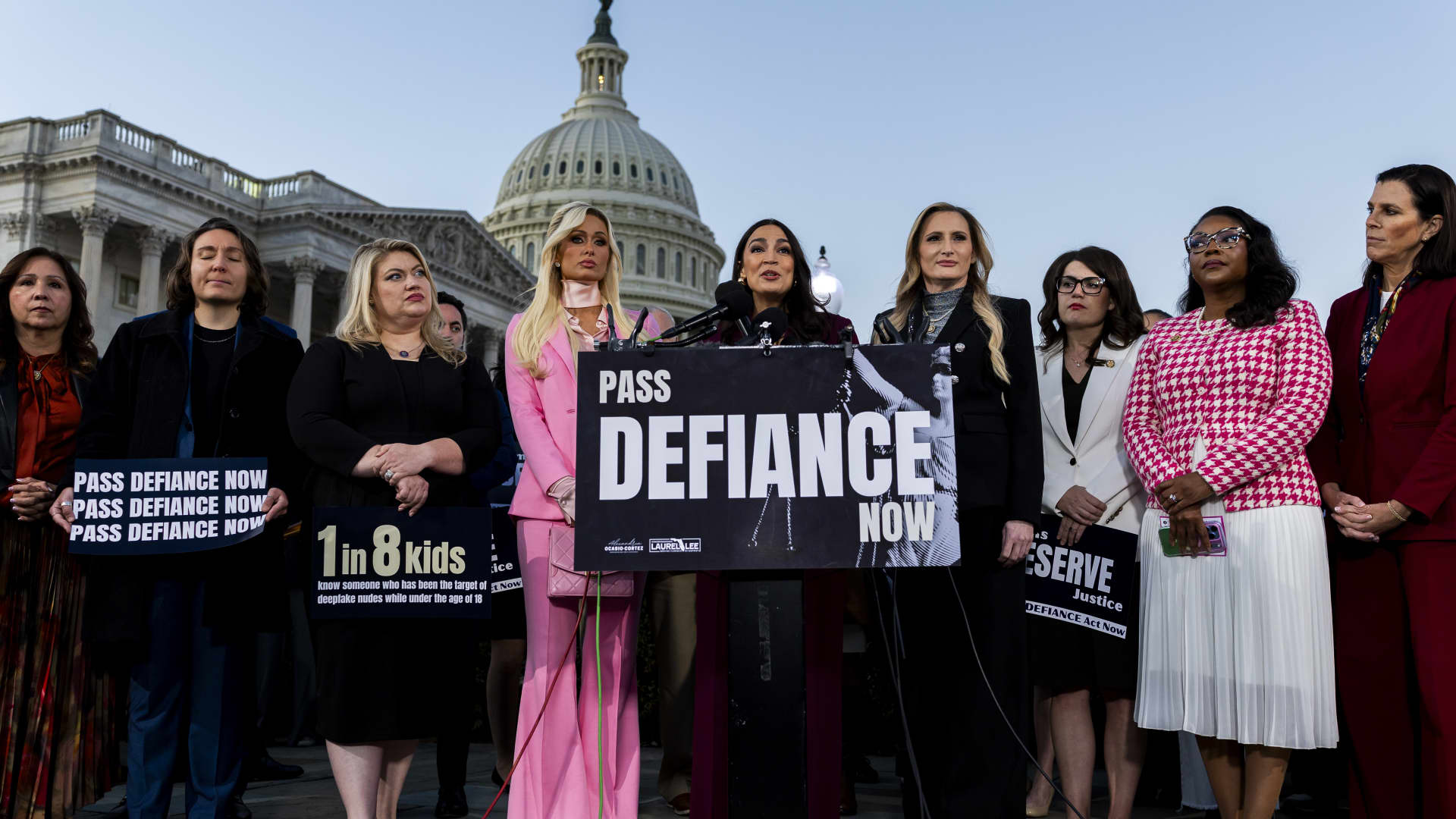
Paris Hilton, Representative Alexandria Ocasio-Cortez and Representative Laurel Lee urged the House to hold a DEFIANCE Act House vote, pressing for legislation that would expand civil remedies for people depicted in nonconsensual sexually explicit digital forgeries. The bipartisan bill cleared the Senate by unanimous consent on January 13, 2026, but Congress.gov lists it as held at the House desk, rather than passed by the House or enacted.
Hilton joined Ocasio-Cortez, a New York Democrat, and Lee, a Florida Republican, at a Capitol news conference calling for action on the measure. The proposal is formally the Disrupt Explicit Forged Images And Non-Consensual Edits Act of 2025.
What would the DEFIANCE Act do?
The bill would amend an existing federal civil-action provision concerning intimate images to include certain nonconsensual intimate digital forgeries. Under the Senate-passed text, such a forgery would be a realistic-looking intimate depiction of an identifiable person that falsely portrays that person or purported intimate conduct and is made or altered using software, machine learning, artificial intelligence or other technology.
If enacted, the measure would provide a civil route for victims to pursue people alleged to have created, disclosed, solicited or threatened to disclose covered material without consent. CNBC reported that proposed remedies could include damages, legal costs and court orders for removal. CBS News reported that the bill would also allow victims to seek profits earned from the images and establish a 10-year period for bringing claims, beginning when a victim discovers the violation or turns 18, whichever comes later.
The Senate measure was introduced by Senator Richard Durbin, an Illinois Democrat, in May 2025. Congress.gov records its latest action as being held at the House desk on the day of its Senate passage.
How does it differ from the Take It Down Act?
The DEFIANCE Act would add a private civil path against alleged creators or distributors of covered explicit digital forgeries. It would operate alongside the Take It Down Act, which, according to CNBC and CBS News, made certain nonconsensual disclosures of authentic and AI-generated intimate imagery a federal crime and requires covered platforms to remove reported material and known identical copies within 48 hours of a valid request.
Hilton said in an interview with CNBC that Loti AI, a digital-identity protection company where she serves as chief advocacy officer, had identified more than 100,000 explicit deepfakes depicting her and helped remove more than 60,000. Those figures were her account and were not independently verified in the reports.
The proposed bill includes congressional findings that intimate digital forgeries can interfere with a person’s privacy, reputation, education, employment and sense of safety. Those findings describe Congress’s stated basis for the legislation, rather than independent estimates of the scale of the problem.
House leaders had not scheduled a vote as of the Capitol event. CBS News reported that Speaker Mike Johnson’s office did not respond to its request for comment on why the measure had not advanced.
This story draws on original reporting from CNBC.