France and India court AI groups for data center and chip investment
Macron and Modi are using direct outreach to tech chiefs as France and India seek AI infrastructure while the U.S. and China remain ahead.
By Marcus V. Thorne · Markets Editor
· 4 min read
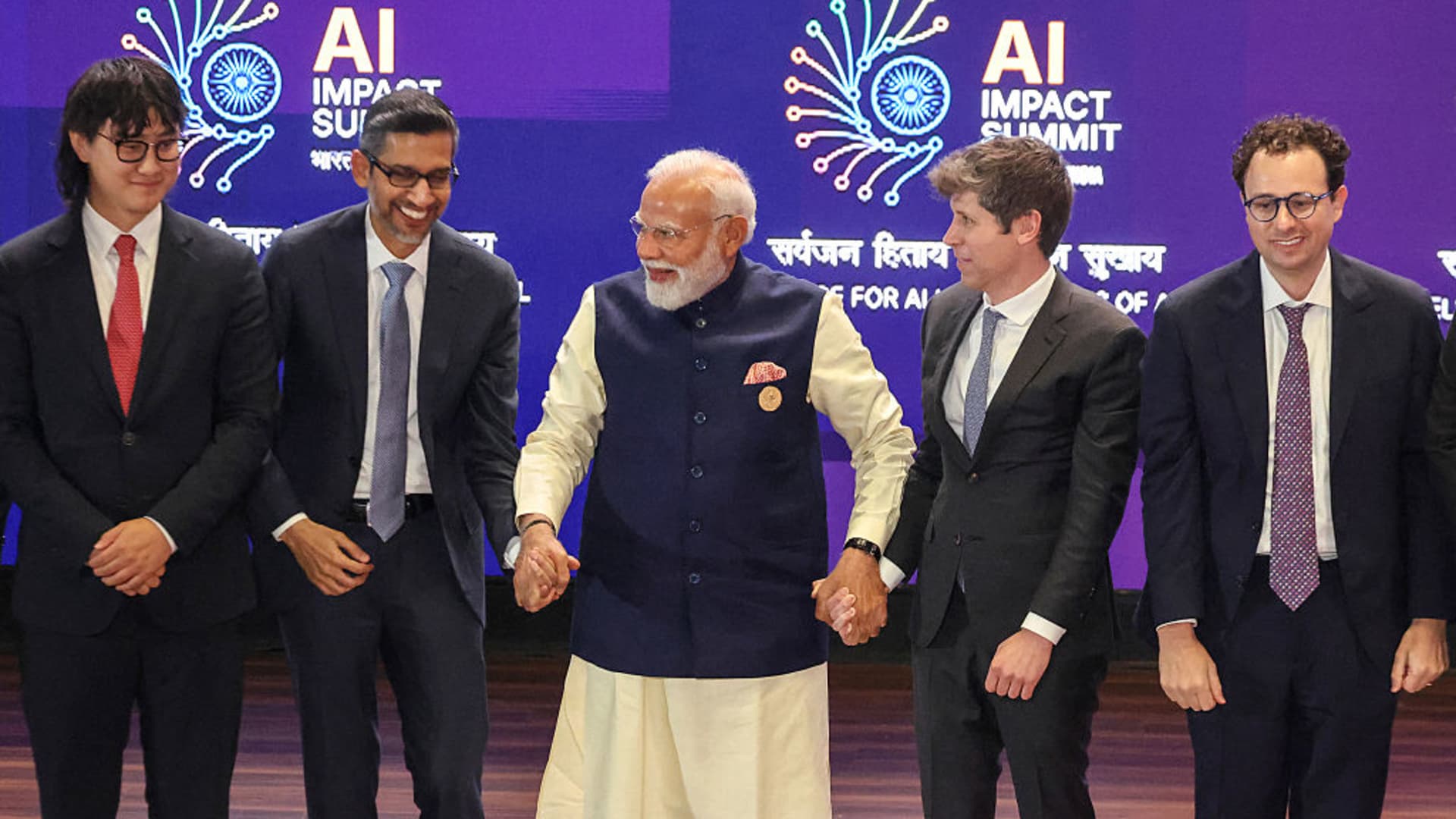
France and India are intensifying direct appeals to global technology executives as they compete for artificial intelligence data centers, cloud infrastructure and semiconductor investment. CNBC reported that President Emmanuel Macron and Prime Minister Narendra Modi have made personal engagement with tech chiefs a central tool in efforts to close the gap with the U.S. and China in AI.
The competition is increasingly tied to physical infrastructure. Advanced AI systems require large data centers, steady electricity supply, cloud capacity and access to high-end chips. Governments seeking domestic AI capacity are therefore trying to secure both capital spending and long-term operating commitments from the companies that build or buy that infrastructure.
Macron presses France’s power case
In May, SoftBank announced plans to build 3.1 gigawatts of AI data centers in France by 2031, CNBC reported. The projects form part of a 75 billion euro program intended to deploy 5 gigawatts of AI data center capacity.
SoftBank chief executive Masayoshi Son told CNBC that Macron had asked to meet him two months earlier to press the case for the investment, with the two men exchanging text messages as terms were discussed. Son said Macron highlighted France’s electricity capacity, including its substantial nuclear generation, and undertook to secure 3 gigawatts for SoftBank’s projects after initially suggesting 2 gigawatts.
“His team, the government team is very supportive,” Son told CNBC. “His team and our team work in collaboration very well.”
Macron also brought AI executives into the diplomatic setting around the G7 summit in June, according to CNBC. OpenAI chief executive Sam Altman, Anthropic chief executive Dario Amodei and Google DeepMind chief executive Demis Hassabis attended a working lunch with world leaders, including U.S. President Donald Trump. Other participants included Mistral’s Arthur Mensch, Cohere’s Aidan Gomez, Domyn’s Uljan Sharka, Synthesia’s Victor Riparbelli and Black Forest Labs’ Robin Rombach.
Modi seeks AI and chip capacity
India has also used high-level meetings to attract technology investment. Modi met Amazon chief executive Andy Jassy last Thursday and welcomed what he called the company’s “record $48 billion investment” in India. Jassy said in a post on X that $21 billion of that total would be directed to AI and cloud infrastructure.
Modi met Microsoft chair and chief executive Satya Nadella, Google chief executive Sundar Pichai and Intel chief executive Lip-Bu Tan last year, according to posts cited by CNBC. Those executives committed to support development of India’s AI ecosystem.
At India’s Global AI summit in February, Modi hosted senior U.S. technology leaders, with CNBC reporting that the event produced commitments worth hundreds of billions of dollars for Indian AI initiatives. “India does not see fear in AI. India sees fortune in AI. India sees the future in AI,” Modi said in opening remarks published by the prime minister’s office, while urging companies to “Design and Develop in India.”
India’s push reflects gaps in its domestic AI base. CNBC reported that the country does not yet produce cutting-edge chips at home and lacks a frontier-scale foundation model comparable with leading U.S. or Chinese systems. The government has encouraged foreign technology groups to build AI infrastructure and chips in India, including through long-term tax breaks for hyperscale data center operators, according to CNBC.
Microsoft made what CNBC described as its largest investment in Asia to support India’s sovereign AI capabilities. Google separately announced a $15 billion investment to build its largest AI hub outside the U.S. in India, according to CNBC.
India is also seeking to expand semiconductor manufacturing. During Modi’s May visit to the Netherlands, ASML said it would supply advanced lithography tools and related solutions for a 300 millimeter semiconductor fabrication plant being built by Tata Electronics, according to the Indian prime minister’s office. Intel’s Tan, who met Modi in December, signed on as a prospective buyer of chips from Tata Electronics, CNBC reported.
CNBC reported that India’s dependence on foreign AI models and computing hardware leaves its ambitions exposed to other countries’ export controls. It also said the global rally in AI-related stocks has largely bypassed India because the market lacks a large-scale listed AI company.
This story draws on original reporting from CNBC.


